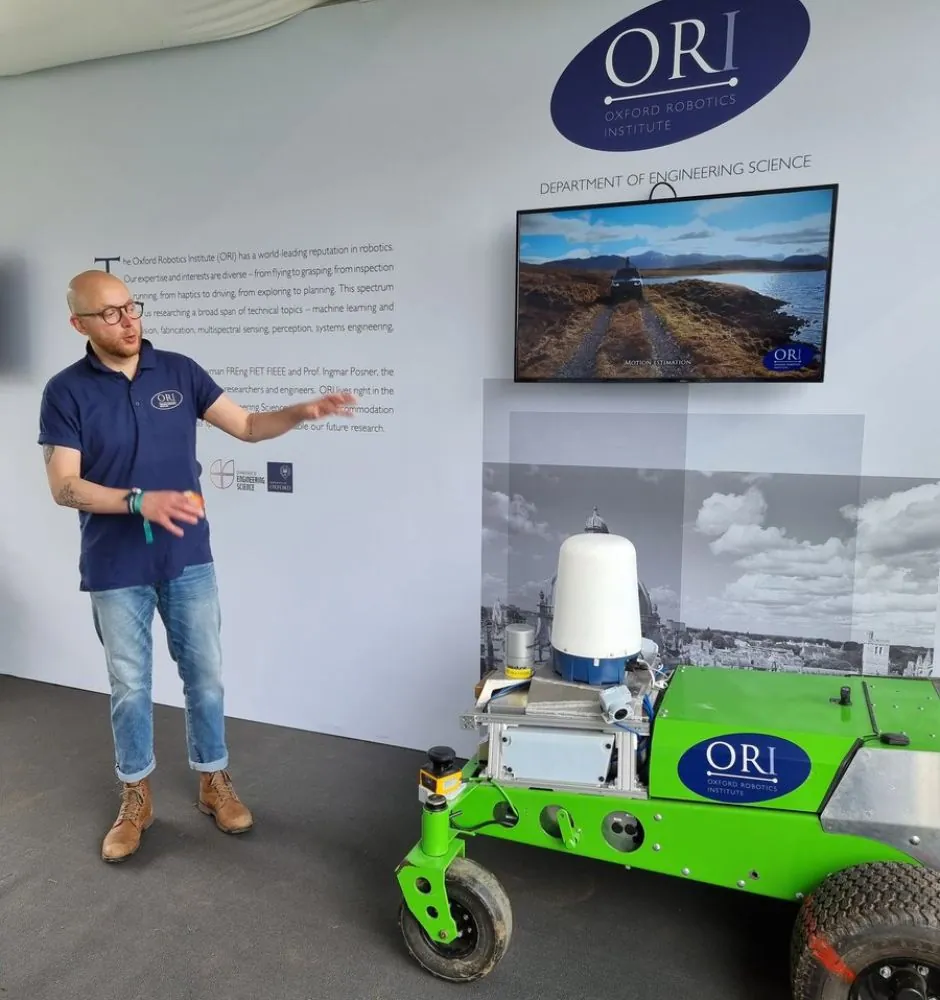
The director of the Oxford Robotics Institute debunks the myths
Nick Hawes is one of the leading figures in the world of artificial intelligence and robotics. He is a professor at the University of Oxford and director of the Oxford Robotics Institute. Hawes leads cutting-edge research. His experience covers deploying robots in extreme environments – from nuclear sites to the depths of Loch Ness.
In this exclusive interview, Hawes reveals which technological breakthroughs are truly transformative. He also discusses the practical challenges of bringing AI into business.
Autonomy: The real breakthrough in robotics
Professor Hawes stresses that the most exciting thing in robotics today is growing autonomy.
- What is autonomy? These are robots that can work on their own. They make decisions without direct human intervention, using on-board artificial intelligence.
- Real applications: This autonomy is no longer a fantasy. It's widely used in logistics and is increasingly entering inspections.
- Examples: quadruped robots or drones fly automatically. They look for changes or problems at sites, reducing the need for human checks.
Hawes shares his experience with autonomous mobile robots (AMRs). He has deployed them in offices for security and patrolling. Robots have worked autonomously in hospitals and care homes, supporting medical staff. His team has also used underwater robots in Loch Ness. Robots have also worked in the radioactive environment around the JET fusion reactor. For months on end, these robots carried out tasks with minimal human involvement. This shows how far autonomy has come, even within a limited set of tasks.
Foundation models: compressing knowledge
Artificial intelligence is also undergoing a huge transformation.
- Foundation models: There is huge excitement around large language models (LLMs), and also around “vision-language-action” models. These models effectively compress all the knowledge on the internet. They enable fast queries against specialized data sets.
- Use in robotics: Roboticists use these models. They help robots understand the scenes around them. This gives them more general capabilities to act in unstructured environments.
- Humanoids: There is great interest in humanoid robots. Hawes, however, is a realist. At the moment he wouldn't recommend deploying them in business. Even so, concrete use cases are expected within the next five to ten years. He advises avoiding unnecessary risks with immature technology.
The hidden risks: energy, law and incomplete planning
For all its benefits, deep AI adoption carries risks that shouldn't be ignored.
- Copyright and legal aspects: The biggest drawback is that we don't know how to use AI very well. The legal aspects, such as copyright, are unclear. Bringing AI into workflows carries significant risk.
- Energy needs: One of the biggest concerns is energy consumption. Everyone who uses AI contributes to the climate crisis. Hawes is curious how AI's carbon footprint affects industries. The cost of training and inference is an often overlooked factor.
- Hallucinations and control: Developers are trying to deal with AI's hallucinations and unpredictability. They are looking for ways to focus the use of language models and limit their output to predictable areas.
The advantage of flexibility and the weakness of planning
The real benefits of AI lie in automating tasks.
- Task automation: AI now makes it possible to automate a wider range of tasks. Examples include chatbots, data extraction, prototyping and code generation. Before AI, these tasks were very hard to automate.
- Flexibility: The emergence of large models allows greater flexibility and generality within a given task. Input data can be less structured. This makes it possible to solve problems that couldn't be solved before.
- Limits in planning: We shouldn't get carried away. These systems are mostly one-shot processes. They can carry out one dialogue or generate one image. Current AI systems are not effective enough at coordinating multiple separate tasks. Booking a holiday or organizing a delivery requires planning and coordination across multiple domains. This is one of the main areas where AI needs to improve.
Professor Hawes' final conclusion: Realism and demystification
When he addresses an audience, Professor Nick Hawes has one main, clear message: we need to keep our feet firmly on the ground.
- Demystification: He wants to demystify AI and autonomous robotics. “These are important and exciting tools that society will use,” he says.
- No exaggeration: We shouldn't get carried away by the hype and attribute too many capabilities to them. They are not a solution to everything.
- Tools, not identities: Robots and AI are software and hardware tools. We shouldn't suddenly give them human identities or excessive abilities. There are real limitations in these technologies.
- Two sides of the coin: Hawes aims to communicate both the excitement and the possibilities (what they can do) and the limitations (what they can't do and what to watch out for).
- A more realistic future: His goal is for people to leave his talks with a better, more realistic understanding of these exciting technologies and the future that awaits us with them.
The full interview with Professor Nick Hawes can be read at: https://www.therobotreport.com/oxford-robotics-institute-director-discusses-truth-about-ai-robotics/
On the Artec Robotics “News” page you will find a variety of articles and guides on robotics and automation. Here you'll find useful information about the latest technologies, software solutions and programs. They will help you dive deeper into the world of industrial robots and automated systems.
Follow the news from Artec Robotics!
MAKE AN INQUIRY