info@artec.bg +359 889 557 337
Artec Robotics
Industrial processes

Roller Hemming Process

Home / Portfolio / Roller Hemming Process

Roller hemming (Roller Hemming Process) with an industrial robot

In the automotive and manufacturing industries, roller hemming (Roller Hemming Process) is one of the most important processes for shaping and joining metal panels. The technology is widely used to manufacture doors, hoods, fenders and other parts where a strong, precise fold is needed along the edges of the sheet metal.

With the arrival of Industry 4.0 and robotic automation, roller hemming is carried out almost entirely by industrial robots, which ensure high accuracy, flexibility and productivity. In this article we will look at:

  • What the Roller Hemming Process is;
  • The advantages of robotic automation;
  • The main stages of the process;
  • Practical applications and benefits for industry.

What is roller hemming and why does it matter?

Hemming is the process of folding the edge of one metal panel (the outer panel) around the edge of another panel (the inner panel). This creates a strong, smooth joint that is vital for parts such as doors, engine hoods, trunk lids and fenders.

While traditional hemming methods use presses and dies, roller hemming is carried out by an industrial robot equipped with a special tool – a roller (flange roller). The robot follows a predefined path along the edge of the part, gradually bending the flange of the outer panel around the inner panel with a controlled force.

The main stages of the process are:

  1. Pre-hemming: The roller slightly bends the flange to a set angle (usually around 45 degrees).
  2. Final hemming: The robot repeats its motion, this time applying greater force to bend the flange all the way (almost 180 degrees), firmly fixing the two panels to each other.

This method offers significant advantages over traditional techniques:

  • Flexibility: The robot can easily be reprogrammed for different part geometries, which is ideal for production with a varied product range.
  • High precision: The controlled force and the robot's motion accuracy ensure exceptional hem quality without surface distortion.
  • Efficiency: The process is faster and requires less setup time than press-based methods.
  • Lower costs: Using a robot reduces the need for expensive, part-specific dies and presses.
 

The technology behind the process

The success of roller hemming comes from combining advanced robotics with specialized tools:

  • Industrial robot: Six-axis robots with high payload capacity and repeatability are typically used. They are programmed with precise paths that take into account the shape of the part and the force required.
  • Hemming tool: This is the robot's head, containing one or more rollers. The roller is designed to distribute pressure evenly to avoid damaging the panels.
  • 3D scanning and simulation: To ensure perfect execution, the entire process is simulated in advance in a software environment. 3D scanning analyzes even minimal deviations in the parts, allowing the robot to adapt its path in real time if needed. This technology is an essential part of the Industry 4.0 concept and the production digital twin.
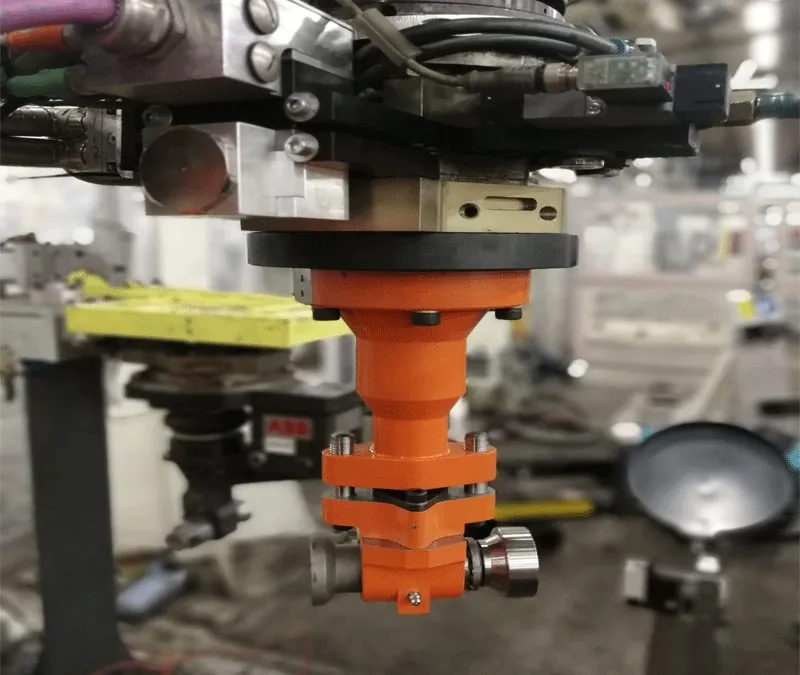
     
Roller Hemming Process

Applications in the automotive industry

Roller hemming is widely used in the production of:

  • Car doors: To join the outer and inner door panels.
  • Trunk lids and engine hoods: To ensure a strong, smooth joint around the perimeter.
  • Fenders: To assemble panels along complex curved shapes.

This technology has become the standard in premium car manufacturing, where assembly quality and a flawless appearance are a must. It allows manufacturers to achieve higher productivity, reduce errors and adapt faster to changing design requirements.

Contact us

Make an inquiry