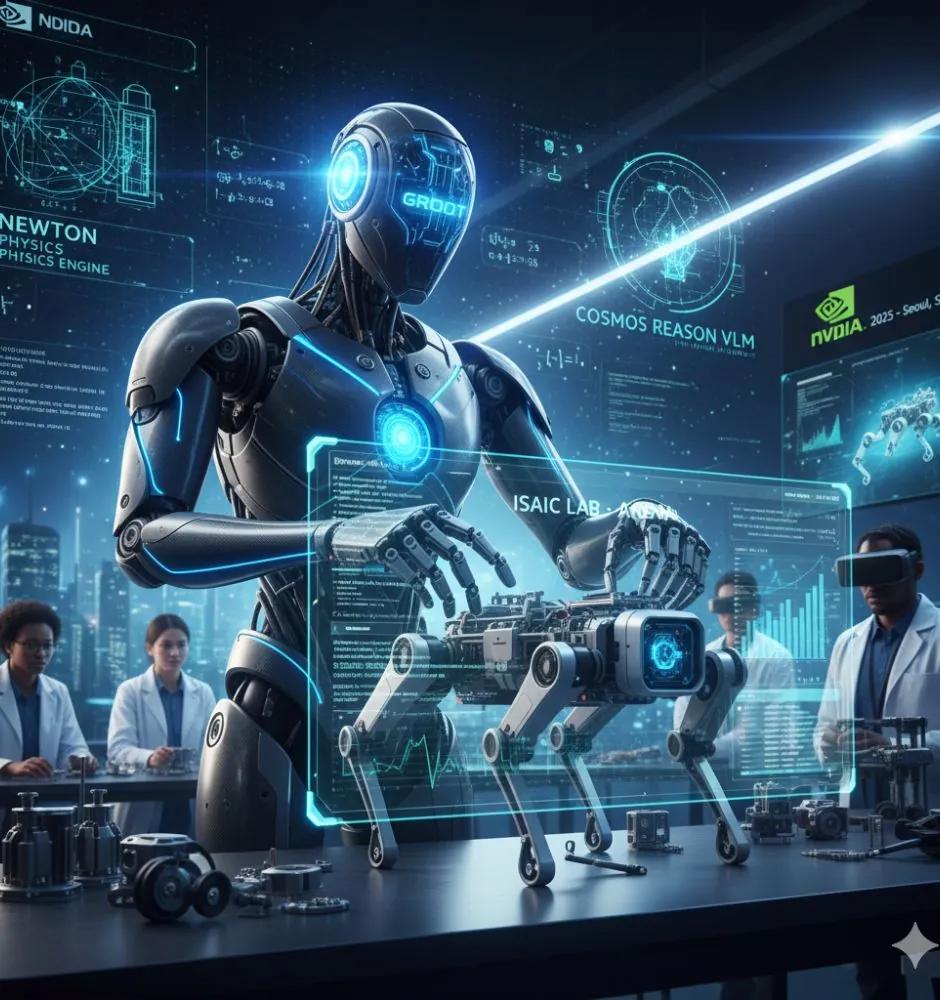
At the Conference on Robot Learning (CoRL) 2025 in Seoul, South Korea, NVIDIA Corp. presented key innovations. These announcements mark a new era in the development of AI robotics. The focus is on Physical AI – intelligent systems that don't just analyze data but can reason, adapt and act effectively in the real world.
Newton: The new physics engine for robots
NVIDIA announced the beta of Newton. It's an open-source GPU-accelerated physics engine, managed by the Linux Foundation.
- Technical basis: Newton is built on the NVIDIA Warp and OpenUSD frameworks.
- Co-development: It was developed together with Google DeepMind and Disney Research.
- Availability: The beta is now available to all robotics developers.
- Main role: Newton simulates the bodies in physical AI environments. It helps robots understand the laws of motion and interaction.
GR00T and Cosmos Reason: the deep-thinking brain of machines
The Newton beta also includes the latest version of the open robot model Isaac GR00T N1.6. This model will soon be available on Hugging Face.
- VLM integration: The new generation of GR00T integrates NVIDIA Cosmos Reason.
- What is Cosmos Reason? It's a Vision Language Model (VLM). It's open, customizable and built for physical artificial intelligence.
- The role of the VLM: Cosmos Reason acts as the robot's “deep-thinking brain”. It turns vague instructions into step-by-step plans, using prior knowledge, common sense and physics. This lets it handle new situations and generalize across many tasks.
- Real-time reasoning: The reasoning runs in real time on Jetson Thor, powered by the NVIDIA Blackwell GPU.
When a robot faces a new task, Cosmos Reason helps it extrapolate from previous experience. It breaks down complex instructions and builds a plan. It applies reasoning techniques to physical scenarios, much as language models reason about text.
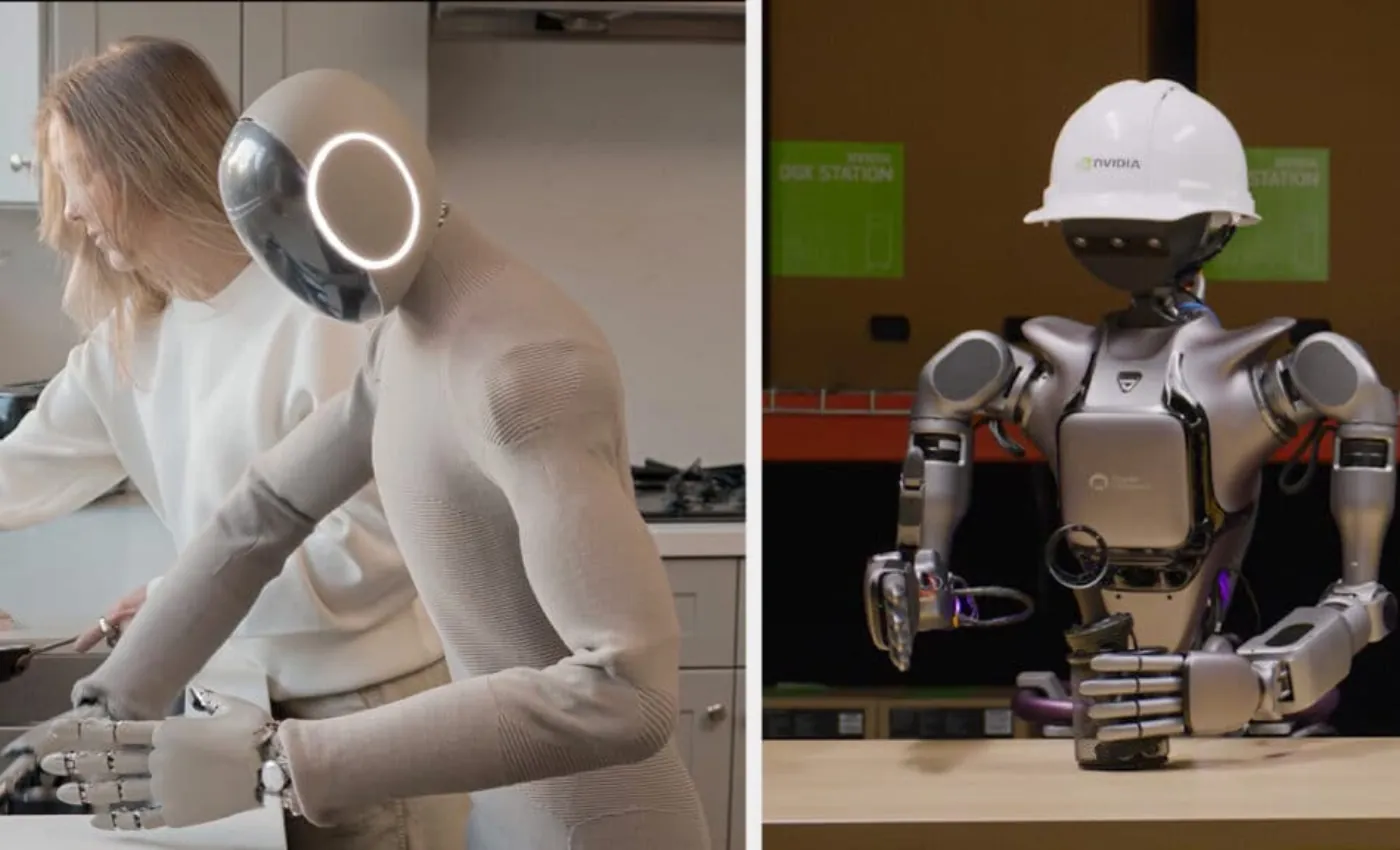
Simulation as a training ground: Omniverse and Isaac Lab
Humanoids are the next big frontier in Physical AI. They require the ability to reason, adapt and act safely.
- The three computers: NVIDIA provides the three computers for bringing robots from research into everyday life:
- Isaac GR00T (the robot's brain)
- Newton (simulates the body)
- NVIDIA Omniverse (the training ground)
Leading manufacturers such as LG Electronics, Mentee Robotics and Neura Robotics are evaluating the Isaac GR00T N models for building general-purpose robots.
A new workflow for dexterous grasping
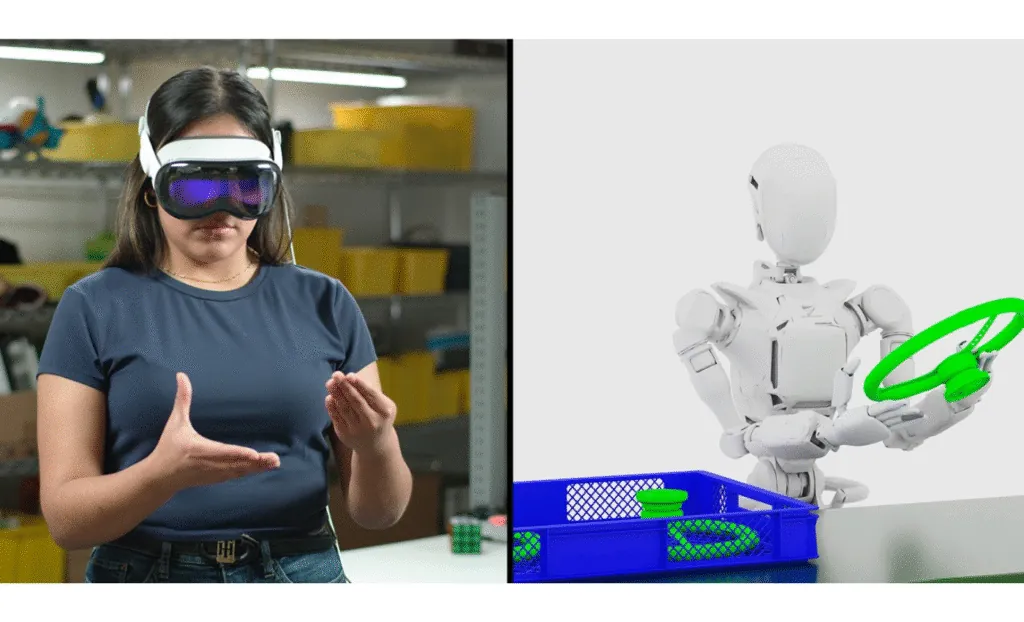
Grasping an object is one of the hardest challenges. It requires turning a thought into precise action.
- Isaac Lab 2.3: The new dexterous grasping workflow is part of the developer preview of Isaac Lab 2.3.
- Training: Built on NVIDIA Omniverse, it trains multi-fingered robots in a virtual world. It uses an automated curriculum, starting with simple tasks and gradually increasing the complexity.
- Robustness: The workflow varies gravity, friction and weight. This teaches robots to master skills even in unpredictable environments.
Application: Boston Dynamics' Atlas humanoid robot uses this workflow. It significantly improves its manipulation capabilities.
Cosmos World Foundation Models (WFM) for large-scale data
To speed up training, NVIDIA has updated its Cosmos WFM models. They let developers generate diverse data at large scale, using text, image and video prompts.
- Cosmos Predict 2.5: This model combines the power of three Cosmos WFMs. This reduces complexity and increases efficiency. It supports generating longer videos – up to 30 seconds.
- Cosmos Transfer 2.5: Delivers faster, higher-quality results. The model is 3.5 times smaller than previous ones. It can generate photorealistic synthetic data from 3D simulations.
Standardized testing with Isaac Lab – Arena
Testing learned skills on a physical robot is slow and expensive. Simulation is the solution.
- The challenge: Developers often create simplified tests. A robot trained in a perfect simulation fails in the complexity of the real world.
- The solution: NVIDIA and Lightwheel are jointly developing Isaac Lab – Arena. It's an open-source framework for scalable experimentation and standardized policy testing. The framework will be available soon.
These innovations show that NVIDIA is at the heart of turning humanoid robotics into reality.
On the Artec Robotics “News” page you will find a variety of articles and guides on robotics and automation. Here you'll find useful information about the latest technologies, software solutions and programs. They will help you dive deeper into the world of industrial robots and automated systems.
Follow the news from Artec Robotics!
MAKE AN INQUIRY