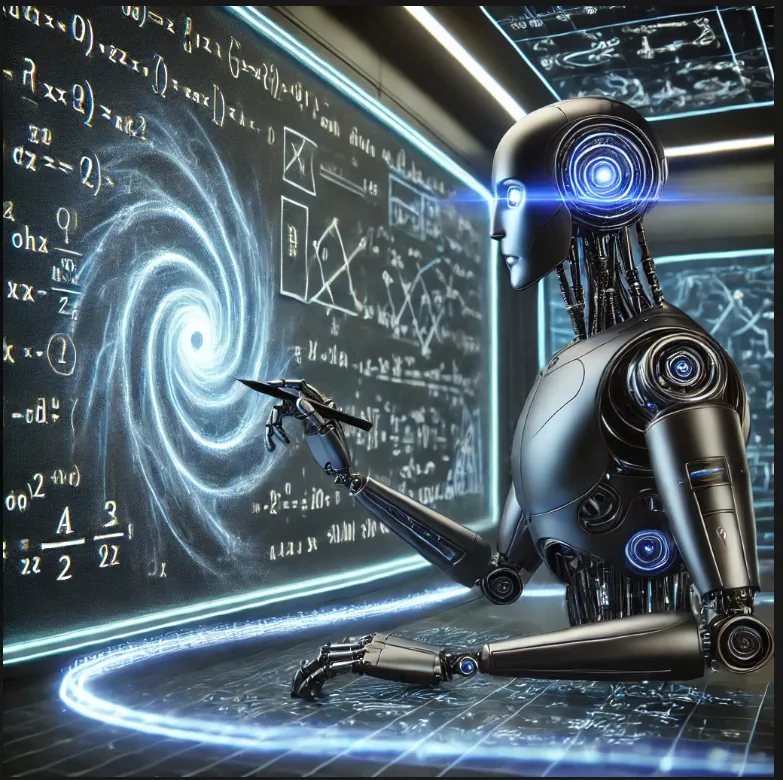
How formulas bring machines to life
Robots are already part of our everyday lives – from smartphones with voice assistants to autonomous cars. But behind every algorithm and mechanism lies something fundamental: mathematics. It's the “language” through which robots see, think and act. In this article we look at how abstract mathematical concepts come to life in robotics, with examples and solutions that demonstrate their power.
1. Kinematics: The geometry of motion
Problem: How does a robotic arm know where to move?
Mathematics: Trigonometry, matrices, systems of equations.
Example: An industrial robot with 6 degrees of freedom. To reach an object, it has to calculate the angles of its joints (inverse kinematics).
Solution:
- The position of the arm is described with homogeneous transformation matrices. For example, for a joint with angle θ:

- The system of equations is solved numerically (using methods such as Newton-Raphson) or analytically.
Result: The robot places components precisely in car manufacturing.
2. Dynamics: The forces behind motion
Problem: How does a drone stay stable in the wind?
Mathematics: Differential equations, vector algebra.
Example: The Euler-Lagrange equations describe the relationship between forces and motion. For a drone with mass m:

Solution: Solving the equations in real time using integration methods (e.g. Runge-Kutta).
Result: The drone corrects its tilt to counteract turbulence.
3. Control: Orchestrating actions
Problem: Why doesn't a robot vacuum bump into the walls?
Mathematics: Linear algebra, PID controllers.
Example: A PID controller calculates the error between the desired and actual position:

Solution: The coefficients Kp, Ki, Kd are tuned for a fast, stable response.
Result: The robot follows a path smoothly, avoiding obstacles.
4. Sensors and perception: The world through data
Problem: How does an autonomous car “see” the road?
Mathematics: Probability, the Kalman filter.
Example: The Kalman filter combines data from GPS, an IMU and cameras:

Solution: An optimal estimate of position even with noise.
Result: The car detects pedestrians with over 99% accuracy.
5. Path planning: Optimization in action
Problem: How does a delivery robot choose the fastest route?
Mathematics: Graph theory, algorithms such as A*.
Example: The map is modeled as a graph with nodes and edges.
Solution: The A* algorithm finds the shortest path by minimizing the function:

where g(n) is the actual distance and h(n) is a heuristic estimate.
Result: The robot delivers orders in 10 minutes instead of 30.
6. Machine learning: Robots that learn
Problem: How does a robot recognize gestures?
Mathematics: Linear algebra (tensors), gradient descent.
Example: A neural network with backpropagation:

where η is the learning rate.
Solution: Training with thousands of examples of gestures.
Result: A robot assistant understands commands in sign language.
7. Ethics: The mathematics of morality
Problem: How do autonomous cars make “moral” decisions?
Mathematics: Game theory, decision-making algorithms.
Example: The trolley problem is modeled with a payoff matrix:

Solution: Minimizing losses according to predefined rules.
Result: The systems make transparent, accountable decisions.
8. The interplay between mathematics and robotics: The language of innovation
Problem: How do you design a robot that understands the physical world and makes intelligent decisions?
The answer lies in the symbiosis between mathematical disciplines and the practical tasks of robotics. Here's how abstract formulas come to life in metal and algorithms:
Geometry: The game of space
Problem: How does a robotic arm avoid obstacles as it moves?
Mathematics: Three-dimensional geometry, coordinate system transformations.
Example: A surgical robot has to move around blood vessels.
Solution:
- Objects are modeled as polygon meshes.
- Collision checks with plane equations:

Result: The robot performs minimally invasive operations with an accuracy of 0.1 mm.
Algebra: The code of logic
Problem: How do you automate a repetitive task?
Mathematics: Boolean algebra, systems of equations.
Example: Assembling electronic components on a board.
Solution:
- The process is described with logical equations:

- The system is solved with methods such as Gaussian elimination.
Result: The production line increases its speed by 40%.
Calculus: The art of change
Problem: How can a drone fly smoothly, without sudden jolts?
Mathematics: Differential equations, integrals to minimize “jerks”.
Example: A smooth landing for a drone with variable mass (e.g. when delivering parcels).
Solution:
- Minimizing the third derivative of position (jerk) by integration:

Result: The drone lands like a feather, keeping the cargo intact.
Linear algebra: The matrices that run the world
Problem: How does a robot understand 3D objects from 2D images?
Mathematics: Matrix transformations, singular value decomposition (SVD).
Example: A warehouse robot identifies parts in a randomly arranged box.
Solution:
- Projection from 3D to 2D with the camera matrix:

- Recovering 3D coordinates with the least squares method.
Result: The robot recognizes and picks parts in 0.3 seconds.
Synthesis: Mathematics as the bridge between idea and reality
Without geometry, robots would bump into walls. Without linear algebra, they wouldn't “see”. Without calculus, their movements would look like surfing in a hurricane. Every equation, every matrix and even every derivative are the cells in the DNA of robotics. When mathematicians and engineers work together, they create not just machines but intelligent collaborators that redefine what humanity can do.
The future: Quantum robots and neuromorphic computing
Mathematics keeps pushing the boundaries:
- Quantum algorithms for optimizing robot swarms.
- Biomorphic computing, imitating the human brain through differential equations.
Conclusion
From Pythagoras to Schrödinger, mathematics is the “heart” of robotics. It turns abstract ideas into actions that change the world. And as robots become more and more complex, the only limit is imagination – and, of course, solving the next equation.
On the Artec Robotics “News” page you will find a variety of articles and guides on robotics and automation. Here you'll find useful information about the latest technologies, software solutions and programs that will help you dive deeper into the world of industrial robots and automated systems.
Follow the news from Artec Robotics!
MAKE AN INQUIRY