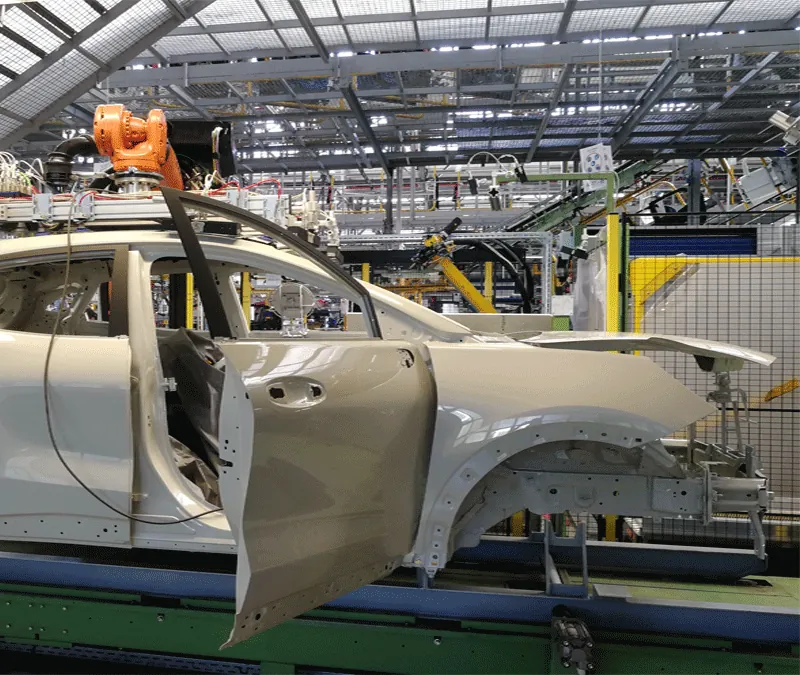
Global industry is undergoing a revolution driven by the rapid deployment of robots in production processes.
According to the latest data from the International Federation of Robotics (IFR), global robot density in factories has doubled in just seven years, reaching a record 162 units per 10,000 employees in 2023. This means more and more companies are relying on robotic systems to optimize their production and meet growing demand.
“Robot density serves as a barometer for tracking the degree of automation adoption in the manufacturing industry around the world,” said IFR President Takayuki Ito. In this context, the leaders stand out: Korea and Singapore, followed by China, Germany and Japan.
Europe – the leader in regional robot density
At regional level, the EU is ahead of the rest with an average density of 219 robots per 10,000 employees, representing an increase of 5.2% compared with 2022. Among the EU countries leading in robotization are Germany, Sweden, Denmark and Slovenia – all in the global top 10.
North America is also making progress, with 197 units – growth of 4.2% year on year. In Asia this figure reaches 182 units, with the highest annual growth of 7.6%. Countries such as Korea, Singapore, China and Japan dominate the global top 10 of the most automated countries.
The Republic of Korea – the world leader in robot density
The Republic of Korea holds the top position with an impressive 1,012 robots per 10,000 employees. Since 2018, robot density in the country has increased by an average of 5% a year, supported by strong electronics and automotive industries.
Singapore is in second place with 770 robots per 10,000 employees, the result of a small manufacturing workforce and a high level of automation.
China – in third place with record growth
China climbs to third place with 470 robots per 10,000 employees, overtaking Germany and Japan for the first time. This is the result of massive investment in automation technologies, which has allowed the country to make significant progress despite its huge workforce of 37 million people
Germany, Japan and the US in a global context
Germany and Japan follow China with 429 and 419 robots per 10,000 employees respectively. In Germany robot density has grown by 5% a year since 2018, while Japan recorded 7% annual growth over the same period.
The US ranks eleventh with 295 units in 2023, a moderate improvement on 285 units in 2022. Nevertheless, the country is falling behind in the global ranking, dropping from ninth place in 2021 to eleventh in 2023.
Conclusion
The IFR report highlights that robotization isn't just an indicator of technological development but also a driving force for the global manufacturing industry. With progress in Asia and Europe, and significant investment in automation, global industry continues to become increasingly robotized.
MAKE AN INQUIRY