Industrial robotics and automation are among the fastest-growing fields in modern industry. More and more manufacturers are deploying automated systems and collaborative robots to optimize processes, improve quality and cut costs. For people who want to retrain for this field, choosing the right programming language is key. Python is among the most popular languages thanks to its readability, accessibility and powerful libraries.
The advantages of Python in automation:
- Easy integration and data management: Python is excellent for collecting, analyzing and visualizing data from sensors, PLCs (Programmable Logic Controllers) and other industrial systems. Libraries such as Pandas and NumPy make processing large data sets easy.
- Rapid prototyping and development: Python's relatively short, readable syntax lets engineers write and test new algorithms and control logic much faster, which is key in the dynamic world of automation.
- Machine learning and artificial intelligence (AI/ML): Robotics increasingly relies on AI for decision-making, object recognition (computer vision) and process optimization. Python is the standard language in AI/ML, thanks to libraries such as TensorFlow and PyTorch.
- ROS (Robot Operating System) compatibility: Although ROS also uses C++, Python is the main scripting language for quickly writing nodes, managing communication between robot components and testing.
- Test and configuration automation: Python is often used to write scripts that automate processes such as hardware testing, report generation and production line configuration.
Why is Python ideal for a career change?
If you're considering a move into industrial automation, learning Python is one of the best investments you can make.
- Exceptional readability: Python's syntax is designed to be intuitive and very close to natural language, which makes it easy to learn for people with no previous programming experience. This flattens the learning curve and lets you start writing working code quickly.
- A high level of abstraction: As a high-level language, it lets you focus on the logic of automation rather than the complex details of memory management (as in C/C++), which speeds up retraining.
A common language for different roles: Knowing Python opens doors not only in robotics but also in Data Science, Web Development (back-end) and IT automation, giving you flexibility on the job market.
Python's core principles
Python's philosophy is best summed up in the so-called “Zen of Python” (Zen of Python), a set of 20 guiding principles (only 19 of which are written down) that emphasize readability and simplicity.
- Beautiful is better than ugly. (rule 1)
- Explicit is better than implicit. (rule 2)
- Simple is better than complex. (rule 3)
- Complex is better than complicated. (rule 4)
- Flat is better than nested. (rule 5)
- Sparse is better than dense. (rule 6)
- Readability counts. (rule 7)
- Special cases aren’t special enough to break the rules. (rule 8)
- Although practicality beats purity. (rule 9)
- Errors should never pass silently. (rule 10)
- Unless explicitly silenced. (rule 11)
- In the face of ambiguity, refuse the temptation to guess. (rule 12)
- There should be one—and preferably only one—obvious way to do it. (rule 13)
- Although that way may not be obvious at first unless you’re Dutch. (rule 14)
- Now is better than never. (rule 15)
- Although never is often better than right now. (rule 16)
- If the implementation is hard to explain, it’s a bad idea. (rule 17)
- If the implementation is easy to explain, it may be a good idea. (rule 18)
- Namespaces are one honking great idea—let’s do more of those! (rule 19)
These principles lead to code that is easy to maintain, understandable to other team members and less prone to errors, which is critical in industrial applications where safety and reliability come first.
Python syntax basics
1. Indentation
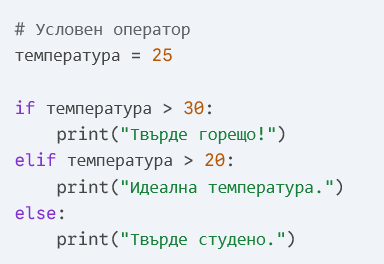
Instead of using curly braces {} (like C, C++ and Java), Python uses indentation – usually four spaces – to define blocks of code (such as the body of a function, a loop or a conditional statement).
- Variables and data types
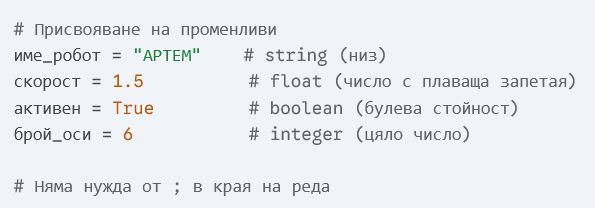
Python is a dynamically typed language. You don't need to declare a variable's type in advance – it's determined automatically at run time.
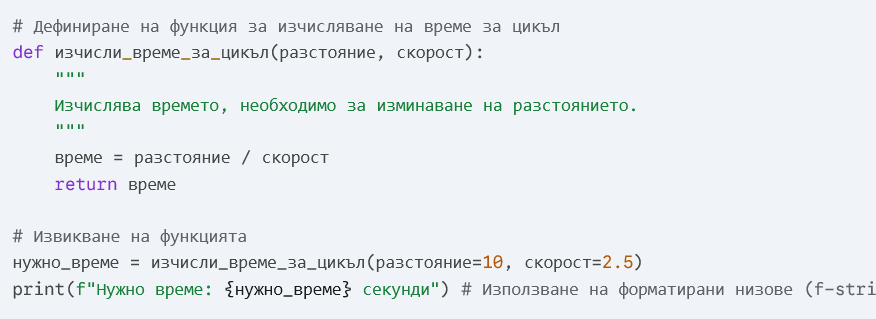
- Functions
Functions are defined with the def keyword.
Python is a strategic tool in industrial automation and robotics. Its ease of learning, combined with the power of its data analysis and AI libraries, makes it the best choice for anyone looking for a successful career change. At ARTEC ROBOTICS we believe knowing Python is the key to unlocking your potential in this high-tech, fast-growing sector. Start your Python journey today!
Use the power of the internet
If you're motivated to make this career move, know that a wealth of learning material is just a click away. Whatever your current level of knowledge, you can easily search for and find hundreds of free and paid Python courses online.
To start your hands-on learning right away, we recommend this excellent introductory video tutorial, which will take you through the basics of the language:
Python from scratch: an introduction for beginners – https://www.youtube.com/watch?v=Ah1OwLc8_uA
On the Artec Robotics “News” page you will find a variety of articles and guides on robotics and automation. Here you'll find useful information about the latest technologies, software solutions and programs. They will help you dive deeper into the world of industrial robots and automated systems.
Follow the news from Artec Robotics!
MAKE AN INQUIRY