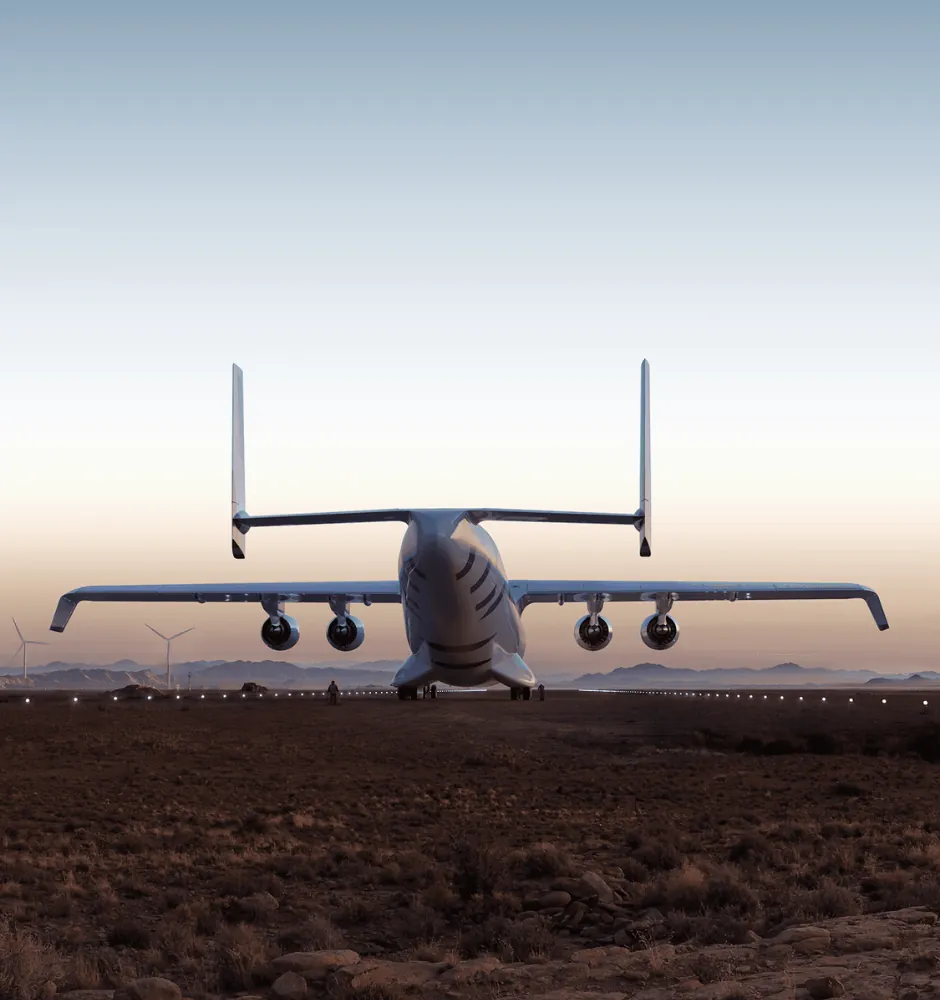
WindRunner: How the world's largest aircraft will double the profitability of wind energy
Aeronautical engineering on an absurd scale: the company Radia is building a giant cargo plane that will get around the limits of road transport and unlock the potential of extra-large wind turbines.
A breakthrough in green energy logistics
Imagine a plane longer than a football field. This giant, called WindRunner, is expected to be ready by 2030 and will carry just one type of cargo: massive wind turbine blades.
Today, the blades of onshore turbines are limited to 70 meters in length. This limit isn't an engineering one but purely a transport one. Larger blades can't pass through tunnels or under overpasses, or handle sharp bends in the road.
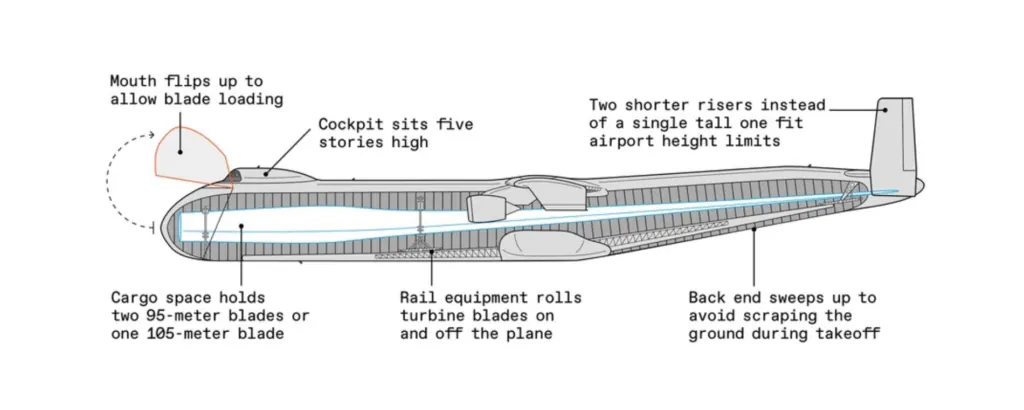
Radia, based in Colorado, is betting its business on the idea that the only way to deliver extremely large blades to wind farms is by air. According to CEO Mark Lundstrom, the industry can make turbines the size of the Eiffel Tower but can't install them on land. WindRunner will be able to carry a blade of up to 105 meters and land on improvised dirt runways next to wind power plants.
Why does size matter?
Why does size matter?
Larger turbines generate much more energy at a lower cost per megawatt.
- More power: Energy output increases with the cube of the wind speed and the square of the diameter swept by the blades. Larger turbines generate significantly more energy.
- Savings: WindRunner and GigaWind turbines could cut the cost of energy by 20 to 35 percent.
- Wider reach: Large turbines don't need such strong winds. This potentially doubles the area of the world where wind energy is viable.
Lundstrom estimates that the new model will halve the number of turbines needed, leading to a significant reduction in the carbon footprint of the steel and concrete, despite the emissions from the jet engines.
WindRunner, an engineering masterpiece
WindRunner required unique design solutions to fulfill its mission:
- Designed for volume: The aircraft is optimized for cargo volume rather than mass – the blades are huge but not dense.
- Short, rough landings: It's designed to take off and land on rough dirt roads (access roads to a wind power plant) within about 1,080 meters. This is achieved with a light structure, a unique wing shape and 20 large tires borrowed from the military C-130 Hercules.
- Powerful engines: The four jet engines are extremely powerful. When empty, the aircraft has a thrust-to-weight ratio comparable to early fighter jets, which helps with short take-offs.
While existing cargo planes and helicopters can't handle the size or weight, and airships are too slow and hard to control in the wind, WindRunner emerges as the only logical solution for scaling up onshore wind energy.
A long-term vision: Beyond fossil fuels
The WindRunner project isn't just a logistics solution but a bold look at the future of energy. Lundstrom argues that increasing the scale at which societies can produce wind energy is crucial to a future without fossil fuels. The new, taller turbines will reach steadier and stronger air currents higher in the atmosphere. This will ensure more stable output. The success of the project is directly linked to the potential to double the viable areas for wind farms around the world. That makes WindRunner a critical component of the global transition to clean energy.
Challenges and unknowns
Despite its ambition, the project is not without criticism and unknowns. Experts such as Michael Howland of MIT note that there is less understanding of the flow physics and engineering of record-sized turbines. Another question is the carbon footprint of the giant aircraft itself. To deliver the blades for a single wind power plant, WindRunner will fly many times. Radia, however, argues that the huge amount of clean energy generated by the turbines will far outweigh the emissions from the jet engines. The project remains a risky but innovative venture that shows the daring spirit of green technology.
On the Artec Robotics “News” page you will find a variety of articles and guides on robotics and automation. Here you'll find useful information about the latest technologies, software solutions and programs. They will help you dive deeper into the world of industrial robots and automated systems.
Follow the news from Artec Robotics!
MAKE AN INQUIRY