
A legacy of geniuses:
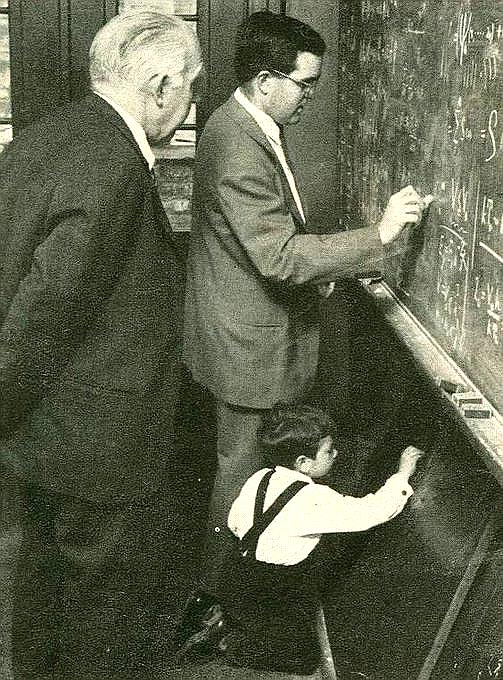
Look at this iconic photo: three generations of Bohrs, each of them a revolutionary in his field. Niels Bohr, the father of quantum mechanics, stands proudly next to his son Aage, who revealed the secrets of the atomic nucleus, and at the bottom sits Tomas Bohr, whose research on fluid dynamics challenges today's technologies. This visual story isn't just about science – it's about passing on a torch that lights the way to innovation.
From quantum leaps to robotic algorithms
Niels Bohr didn't just explain the structure of the atom – he created a language through which we understand the fundamental laws of the Universe. His Nobel Prize in 1922 was only the beginning. His son, Aage Bohr, built on this legacy by studying nuclear forces and popularizing the “collective motion” model in nuclear physics, which even today influences the development of precision sensor systems in robotics.
And the grandson, Tomas Bohr? He carries on the family passion. It's for fluid dynamics. This is a science. It dictates how drones maneuver in the air. It shows how industrial robots optimize hydraulic systems. It even shows how interaction between robots and people is simulated in real time. Tomas Bohr is director of the Center for Fluid Dynamics at the Technical University of Denmark (DTU). He's a bridge between theory and practice.
Lessons for industrial robotics: Legacy as a driving force
What do the quantum theories of the 1920s have in common with modern robots in factories? The Bohr legacy teaches us that every technological revolution is built on a foundation of bold ideas that were once considered “impossible”.
- Quantum mechanics and sensors
Niels Bohr's principles underpin modern quantum sensors, which let robots “sense” with atomic precision. Without his theories of energy levels, today's autonomous systems wouldn't be able to interpret data from the micro to the macro world. - Nuclear physics and resilience
Aage Bohr's work on the stability of nuclei inspires approaches to designing robots that work in extreme conditions – from space to nuclear power plants. His models suggest how to create systems that are resilient to “crashes” and unexpected changes. - Fluid dynamics and the elegance of motion
Tomas Bohr proves that nature is the best engineer. His research on turbulence and nonlinear systems is key to creating faster, quieter and more energy-efficient robots. Imagine a robotic arm that moves liquids with the perfect balance of strength and grace – that's a direct result of this kind of science.
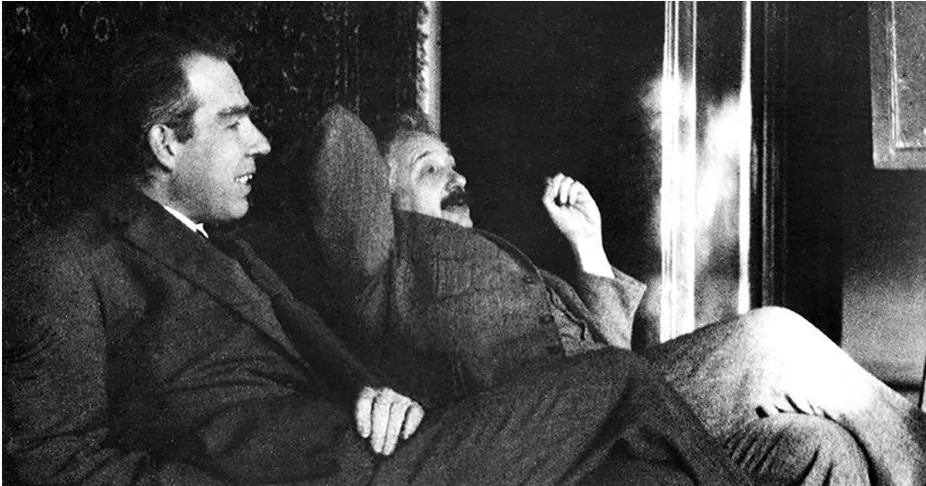
When Bohr first published his discoveries in 1913, Albert Einstein called it “musicality in the sphere of thought”. Later he would go on to say: “If all this is true, then it means the end of physics.”
The Bohr legacy: Robotics as a continuation of human curiosity
The Bohr family aren't just geniuses – they're an example of how intellectual courage is passed down through generations. In the world of industrial robotics, where every algorithm and sensor is the fruit of the collective experience of thousands of scientists, this lesson is critical.
- A culture of sharing: Just as the Bohrs sparked discussion at their institute in Copenhagen, open data-sharing platforms today accelerate the development of robotics.
- From theory to practice: The Bohr legacy reminds us that even the most abstract theories can become the basis of innovation. The quantum computers that will control the robots of tomorrow are proof of this.
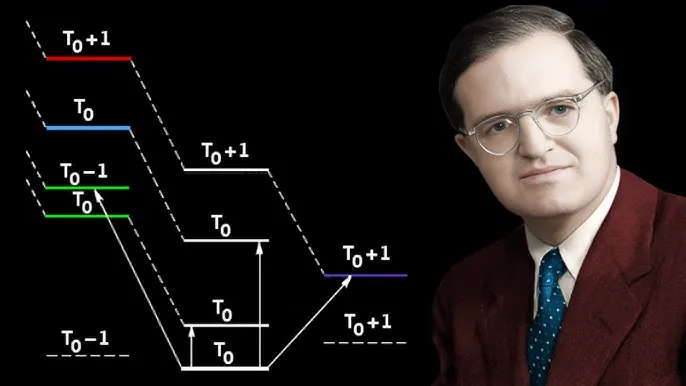
The 1975 Nobel Prize in Physics was awarded jointly to Aage Niels Bohr, Ben Roy Mottelson and Leo James Rainwater “for the discovery of the connection between collective motion and particle motion in atomic nuclei and the development of the theory of the structure of the atomic nucleus based on this connection”
Beyond machines: Humanizing robotics through the Bohr legacy
The Bohr family's legacy is great. It isn't only in the technical aspects of robotics. They were devoted to understanding nature. They were able to think beyond boundaries. This reminds us of an important approach. It's a humanized one. It's needed for the development of artificial intelligence. It's also needed for autonomous systems. Niels Bohr sought depth. He wanted to understand the atomic world. Today we too must strive for this. We must build in ethical considerations. We must also build in human values. This must be in the design of robots. It must also be in how they're used. The Bohr legacy is curiosity. It's a striving for knowledge. If we look at robotics through this lens, we'll succeed. We'll create technologies. They won't just be efficient. They'll serve higher goals. They'll enrich human life. They'll enrich society too.
The future is quantum: The new era of robotic systems
Looking at the future of industrial robotics, we can't ignore the growing influence of quantum technologies. Inspired by Niels Bohr's pioneering work, scientists and engineers are already working on quantum sensors with unprecedented sensitivity and quantum computers capable of solving complex optimization problems beyond today's classical machines. Imagine robots controlled by quantum algorithms that can adapt to changing conditions in real time with incredible speed and efficiency. The Bohr legacy prepares us for this new era, where the boundaries between the possible and the impossible keep blurring, driven by the same unquenchable thirst for knowledge that drove three generations of geniuses.
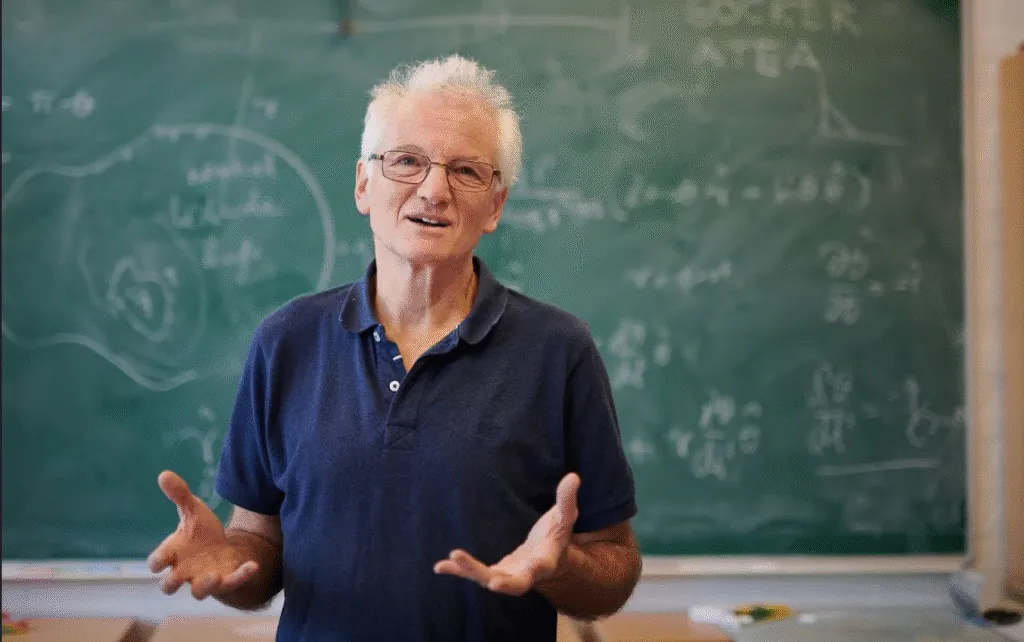
Tomas Bohr is interested in complex systems and chaos theory, turbulence and statistical mechanics, strongly nonlinear fluid phenomena and biological applications of hydrodynamics (fluid flow in plants, plankton in the sea).
What will your “quantum leap” be?
The photo of the three Bohrs is a call to action. Just as they passed on the torch of knowledge, we must build a bridge between today's technologies and tomorrow's dreams. In industrial robotics, this means creating not just machines but systems that carry the DNA of innovation – resilient, adaptive and forever curious.
On the Artec Robotics “News” page you will find a variety of articles and guides on robotics and automation. Here you'll find useful information about the latest technologies, software solutions and programs that will help you dive deeper into the world of industrial robots and automated systems.
Follow the news from Artec Robotics!
MAKE AN INQUIRY