In the dynamic world of industrial automation, fast and reliable communication is critical. PROFINET (from PROcess FIeld NETwork) has established itself as the main standard providing high-speed Ethernet-based communication between controllers, input/output (I/O) devices and other components in production networks. As an open protocol based on standard TCP/IP, it has become the backbone of modern industrial connectivity and a key element of the Industry 4.0 concept. This article aims to introduce you to the PROFINET protocol in detail, covering its basic principles, advantages, architecture and practical use.
What is PROFINET?
PROFINET is an open industrial communication standard developed and maintained by PROFIBUS & PROFINET International (PI). It was designed to replace (or work alongside) fieldbus systems such as PROFIBUS, but with the advantages of Ethernet – higher speed, flexibility and diagnostic capabilities.
Its normative basis includes the IEC 61158 and IEC 61784-2 standards, as well as additional technical descriptions (“system description”, “conformance class”) and profiles such as PROFIsafe and PROFIenergy.
Main elements and architecture
To understand how PROFINET works, it's important to get to know its main architectural elements:
Device types and roles:
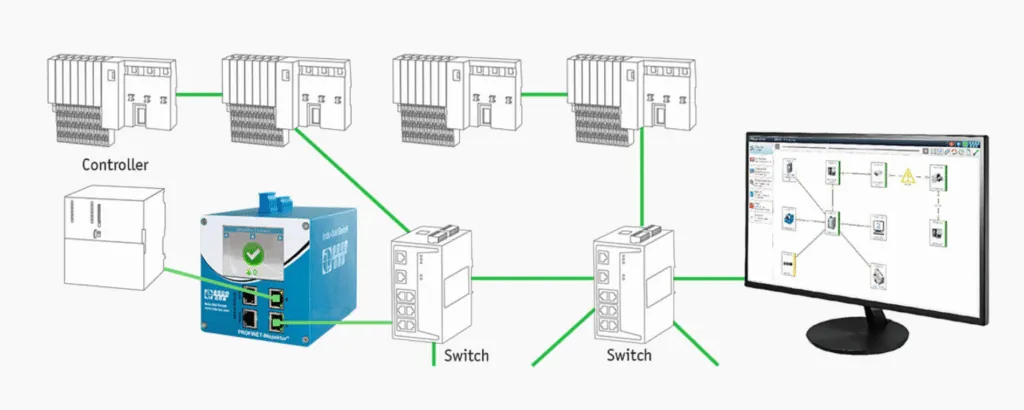
- IO-Controller: The device that manages the network. It sets parameters and receives data, alarms and diagnostic information. It's usually a PLC (Programmable Logic Controller), a DCS or another control device.
- IO-Device: Field devices such as sensors, actuators, discrete/analog I/O modules and other peripherals. They send input data to the controller and receive control commands.
- IO-Supervisor: Software tools or stations used for network configuration, visualization, diagnostics and monitoring. They aren't part of the continuous data exchange cycle but are critical for maintenance and management.
Types of communication:
- Cyclic communication (cyclic data exchange): Used for the regular exchange of input/output values, control and management.
- Acyclic communication (acyclic): Used for one-off operations such as configuration, setup, diagnostics, sending alarms, etc.
Conformance classes (Conformance Classes)
To guarantee device compatibility and functionality, the standard defines conformance classes (CC). The main classes are:
Class | Main characteristics |
CC-A | Basic PROFINET IO functionality – cyclic/acyclic communication, diagnostics and IO-Device/IO-Controller. No specialized real-time (RT) hardware is required. |
CC-B | Added diagnostic functions and topology information. Uses SNMP (Simple Network Management Protocol) and LLDP (Link Layer Discovery Protocol) for better support. |
CC-C | Support for isochronous real time (IRT) – for latency-sensitive applications such as motion control and precise synchronization. Requires bandwidth reservation and hardware-level synchronization. |
CC-D | The latest additions, including TSN (Time Sensitive Networking) and even stricter synchronization and latency requirements. |
Protocol layers and technologies
- Physical layer: PROFINET uses standard Ethernet, such as 100BASE-TX (copper) and 100BASE-FX (fiber), which allows easy integration with IT networks.
- Discovery and configuration: Protocols such as DCP (Discovery & Configuration Protocol) are used for the initial discovery and setup of devices (assigning an IP address or name), and LLDP for discovering neighboring devices and mapping the network topology.
- Real-time communication: To achieve determinism, PROFINET uses specialized mechanisms:
- RT (Real-Time): Bypasses the standard TCP/IP stack for cyclic data, which significantly reduces delay.
- IRT (Isochronous Real-Time): Provides strict determinism by reserving bandwidth and dividing the communication cycle into phases, which is needed for applications requiring precise synchronization.
Practical steps for deployment and installation
Proper planning is key to successfully implementing a PROFINET network. Here are the main stages:
- Planning:
- Defining the requirements: Analyze the application's needs – latency, reliability, number of devices and distances.
- Choosing the conformance class: Choose the right class for your needs, for example CC-C for motion control.
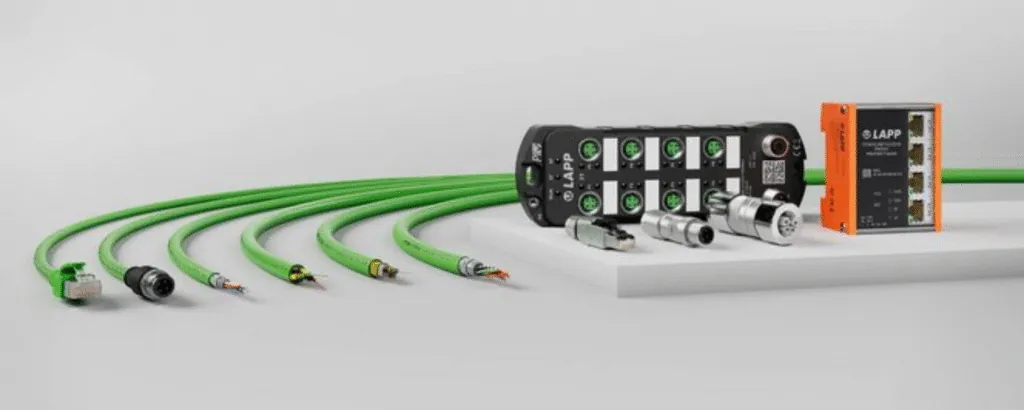
- Choosing the hardware: Select suitable cables (copper, fiber), connectors (M12 for industrial environments), switches and other components.
- Engineering and configuration:
- GSD/GSDML files: Use these files to describe the devices, their ports and characteristics in the engineering software.
- Addressing: Assign IP addresses, device names and the subnet mask.
- Topology: Choose the most suitable topology – star, line or ring, the last of which provides reliability and redundant connections.
- Installation:
- Cables: Lay the cables following the rules for electromagnetic compatibility (EMC), grounding and shielding.
- Tests: Check cable lengths and connection quality.
- Commissioning and maintenance:
- Diagnostics: Use PROFINET's built-in functions to test cyclic traffic and detect problems.
- Monitoring: Deploy IO-Supervisor tools for monitoring and collecting statistics and alarms.
- Device replacement: Use the automatic replacement function (Device Replacement), which allows a faulty device to be swapped quickly without reconfiguration.
Advantages and limitations
Advantages:
- High performance and determinism: Guarantees accurate, reliable communication, especially with the IRT classes.
- Flexibility: Can be used in a wide range of applications – from discrete automation and machine control to process automation.
- Reliability: Diagnostics, device replacement and redundancy functions guarantee continuous operation.
- Integration: Based on standard Ethernet, the protocol allows seamless connection to IT networks and cloud systems, which is key for the IIoT.
Limitations/challenges:
- Complexity with IRT: Very short cycle times (under a millisecond) require specialized hardware and switches, which increases costs and implementation complexity.
- Quality requirements: Correct installation, grounding and EMC protection are essential, and mistakes can be hard to fix afterwards.
- Certification: To guarantee compatibility, certified components must be used.
Summary
PROFINET is a powerful, flexible protocol that combines the advantages of Ethernet with the requirements of industrial automation. A proper understanding of the architecture, configuration and good practices is key to implementing the network successfully. With the right approach, PROFINET provides the reliable, fast communication needed to successfully enter the era of Industry 4.0.
On the Artec Robotics “News” page you will find a variety of articles and guides on robotics and automation. Here you'll find useful information about the latest technologies, software solutions and programs. They will help you dive deeper into the world of industrial robots and automated systems.
Follow the news from Artec Robotics!
MAKE AN INQUIRY