What is a PLC? A complete guide to programmable logic controllers
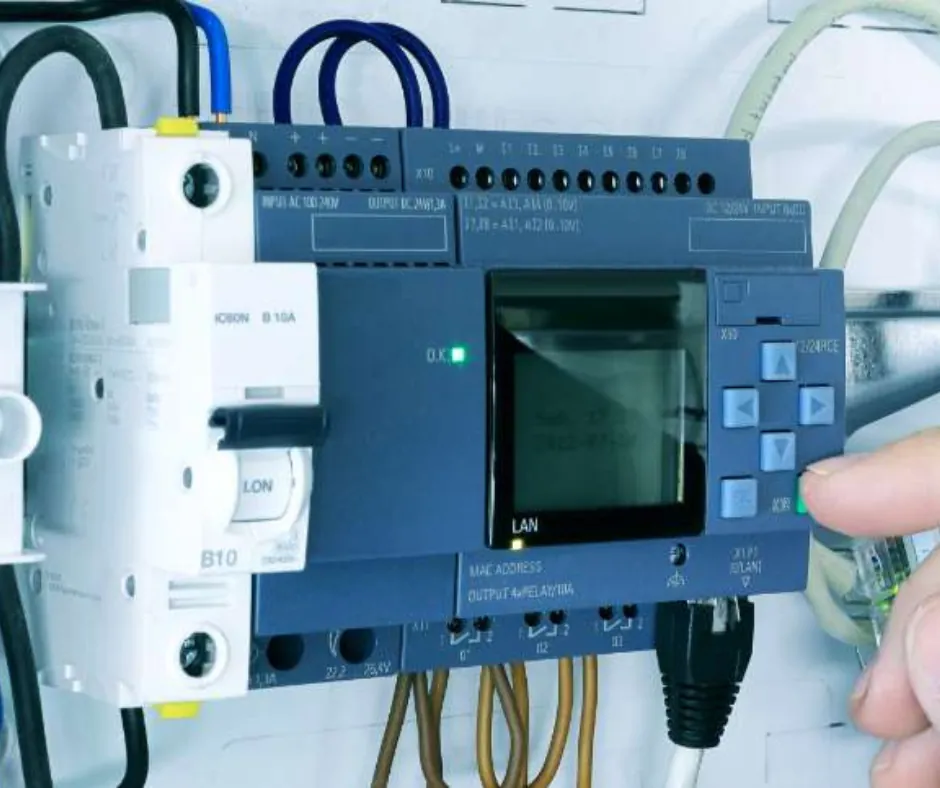
A programmable logic controller (PLC) is a digital industrial computer specially designed to control production processes and automate machines. It serves as the “brain” of an industrial system, processing signals from sensors and other input devices, executing a program of logic instructions and sending commands to actuators to control production. A PLC is built to work reliably in harsh industrial environments that are often exposed to extreme temperatures, vibration, dust and moisture.
Why is the PLC so important? Advantages and disadvantages
Before the PLC came along, industrial processes were controlled with complex relay systems that required a lot of space, difficult wiring and lengthy troubleshooting. The PLC revolutionized industrial automation with a number of key advantages:
- Reliability and durability: It's designed to withstand harsh conditions and is extremely resistant to industrial noise.
- Flexibility: Changes to the production process can easily be made by reprogramming the PLC, instead of rewiring the whole system.
- Easy troubleshooting: Built-in diagnostics allow problems to be identified and solved quickly.
- Compactness: It replaces bulky relay cabinets with one small, light box that's easy to install.
- Expandability: The modular design makes it easy to add input/output channels.
- Communication: It supports industrial communication standards for connectivity in Industry 4.0.
Disadvantages:
- Price: Compared with traditional relay circuits, the price is higher. The cost of the programming software also varies by manufacturer.
- Knowledge required: Users need a basic knowledge of PLC programming to work effectively.
Structure and operating principles
A typical PLC system consists of the following main components:
- Central processing unit (CPU): The heart of the controller. It runs the program, processes the input signals and controls the outputs. The CPU's processing speed determines the speed of the entire control system.
- Memory: Includes RAM, where the program is stored, and ROM, as well as external memory such as EPROM.
- Input/output (I/O) modules: Receive signals from external devices (sensors, buttons) and convert them into commands for the actuators (motors, valves).
- Power supply: Provides the voltage needed for all modules to operate.
- Communication ports: Include RS232, RS422 and RS485 for connecting to a computer, as well as industrial standards such as Modbus RTU, Profibus, Profinet and EtherCAT.
A PLC works on the basis of a cyclic scan that repeats continuously:
- Reading the inputs: The PLC reads the state of all input signals.
- Executing the program: The CPU executes the program code line by line.
- Updating the outputs: The PLC writes the results to its output modules, activating or deactivating the corresponding outputs.
This cycle repeats at extremely high speed, providing precise real-time control.
Applications and how it differs from other systems
PLCs are widely used in almost every industry that needs automation, such as:
- Automotive: Robotic assembly and welding lines.
- Food and textile industries: Control of packaging machines and bottling lines.
- Water supply and energy: Control of pumps, valves and generators.
- General manufacturing: Control of conveyor belts, cutting machines and presses.
PLCs are gradually replacing conventional relay systems, since program changes are easy to make in software and maintenance and repairs are much simpler. Unlike microcontrollers, which suit small, specialized applications, a PLC is designed to work in harsh industrial conditions, has a modular design for easy expansion and is programmed in easier-to-understand languages such as Ladder Logic
On the Artec Robotics “News” page you will find a variety of articles and guides on robotics and automation. Here you'll find useful information about the latest technologies, software solutions and programs. They will help you dive deeper into the world of industrial robots and automated systems.
Follow the news from Artec Robotics!
MAKE AN INQUIRY