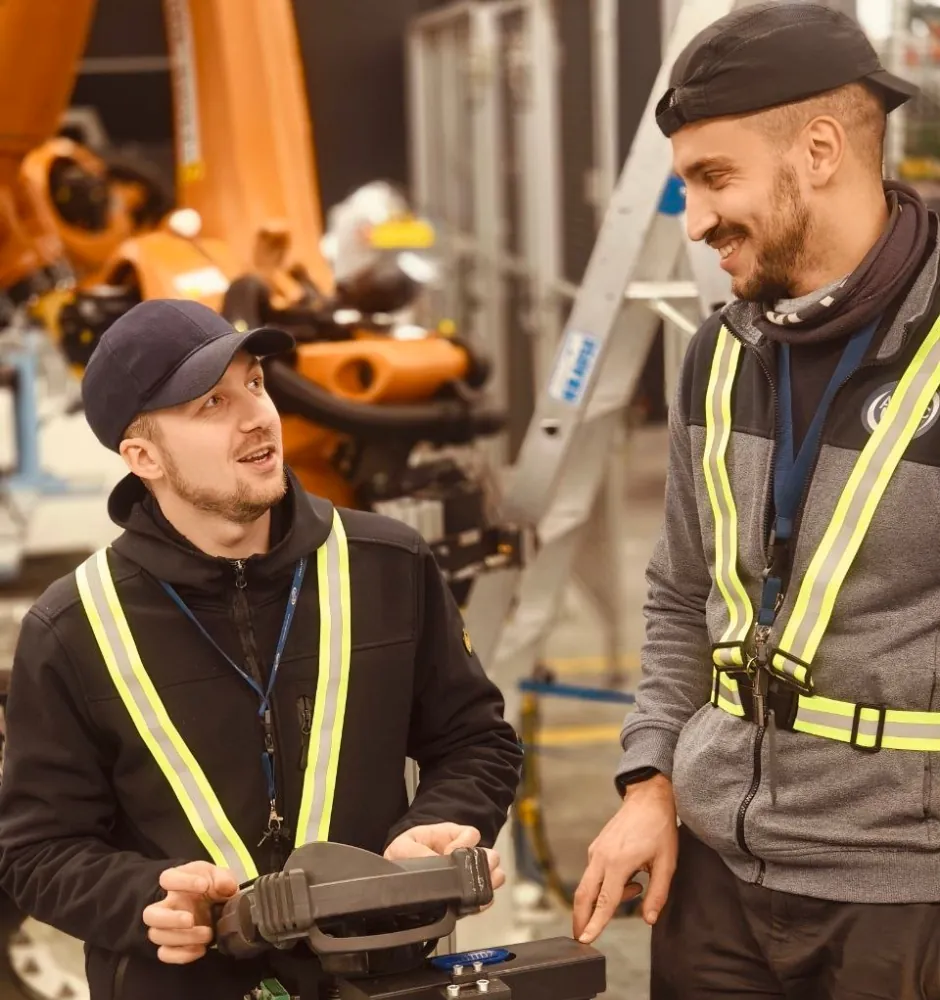
The world of technology is developing at a speed that often outpaces the education system. Until recently it was believed that to program industrial robots you needed a degree in “rocket science”, but today the reality in factories shows something different. The best specialists often come from a variety of technical fields – electrical engineering, classic mechanical engineering or even software development.
Is a complete career change into industrial robotics possible? The answer is a firm “Yes”, but the road to success runs through properly structured preparation and an understanding of the fundamental principles.
What does being a “robot programmer” actually mean?
Unlike traditional software engineering, where the end product is code running in a digital environment, industrial robotics is “programming motion”. Here your code turns into physical action – welding a car body, palletizing heavy loads or precisely assembling electronics.
It's a profession for people who like to see the result of their work in real time. It combines a programmer's logic with an engineer's feel for mechanics and safety.
The technical foundation: Where to start?
If you're considering a career change, you don't need to start from scratch. Many of your existing skills apply directly. Here are the critical pillars of knowledge:
1. Programming languages and algorithmic thinking
Although every leading manufacturer uses its own control language (such as RAPID for ABB or KRL for KUKA, etc.), they are built on universal programming principles. If you have a basic knowledge of C/C++ or Python, the syntax of industrial robots will seem entirely logical and intuitive. The key isn't memorizing commands but mastering logical operators, loops and conditions. This is the fundamental language through which you “translate” complex tasks into a series of intelligent decisions that the robot carries out with millimeter precision.
2. Object-oriented thinking
An industrial line is a complex system of objects. You need to see the robot, the tool (Tool), the part and the surroundings as interacting elements. The ability to define these objects and their properties is what separates a beginner from an expert.
3. Orientation in 3D space
This is the point where many candidates give up, but it's also the most interesting. Robotics is pure geometry in action. You need to master the Cartesian coordinate system ($X, Y, Z$) and understand how the tool's position changes when it rotates around the three axes. A key concept here is the TCP (Tool Center Point) – the point where the tool touches reality
The role of offline programming (Digital Twin)
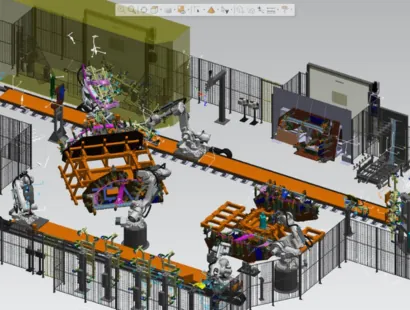
In modern industry, nobody starts programming directly on the real robot. Specialized simulation software platforms are used. They create a “digital twin” of the production line.
Offline programming lets you:
- Test the program in a safe virtual environment.
- Anticipate potential collisions.
- Optimize the cycle time without stopping the customer's production.
Learning this kind of software is an essential step for anyone who wants to work at a high professional level.
Motivation: The most important component
Retraining for industrial robotics goes far beyond earning yet another certificate. It's a complete transformation of the way you think. Successful specialists in this field have a deep “technical curiosity”. They feel an inner drive to break every task down into its components so they can reorganize it in a more efficient and intelligent way.
If you're someone with a creative approach, a good technical background and a drive for continuous improvement, industrial automation offers you a career path that combines high pay with exceptional professional satisfaction. The future of manufacturing belongs to those who have the courage and the skills to control the machines of tomorrow.
On the Artec Robotics “News” page you will find a variety of articles and guides on robotics and automation. Here you'll find useful information about the latest technologies, software solutions and programs. They will help you dive deeper into the world of industrial robots and automated systems.
Follow the news from Artec Robotics!
MAKE AN INQUIRY