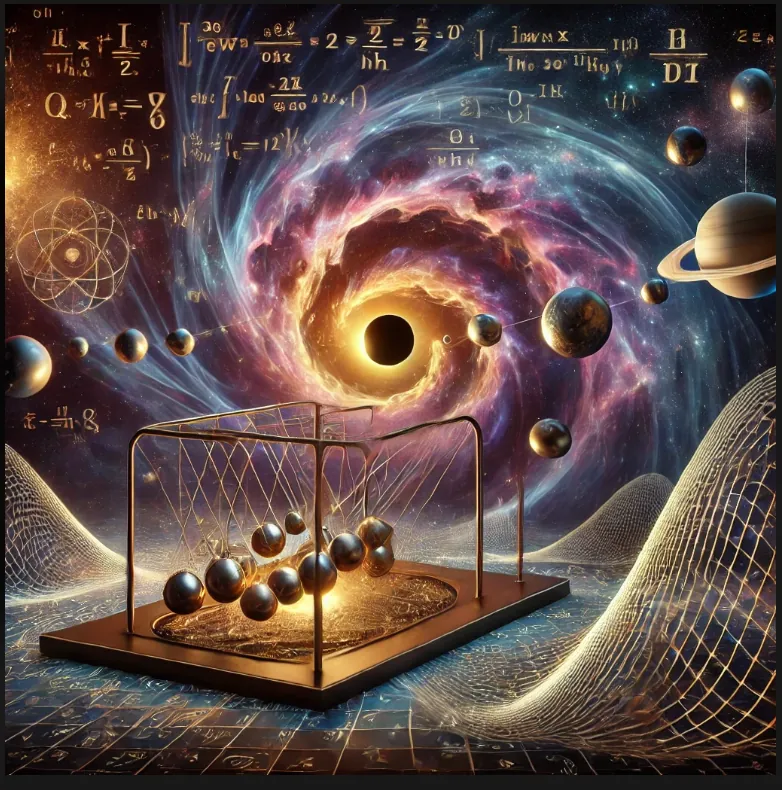
A symbiosis of abstraction and reality
The language of the Universe
“Philosophy is written in this grand book – the Universe – which stands continually open to our gaze. But the book cannot be understood unless one first learns its language: mathematics.”
— Galileo Galilei
With these words the Italian scientist began the centuries-long dialogue between mathematics and physics. The two sciences are like the two wings of a bird: physics describes reality through laws, and mathematics creates the tools for unraveling them. But which comes first? Can one exist without the other? And how does this symbiosis reshape our understanding of the cosmos?
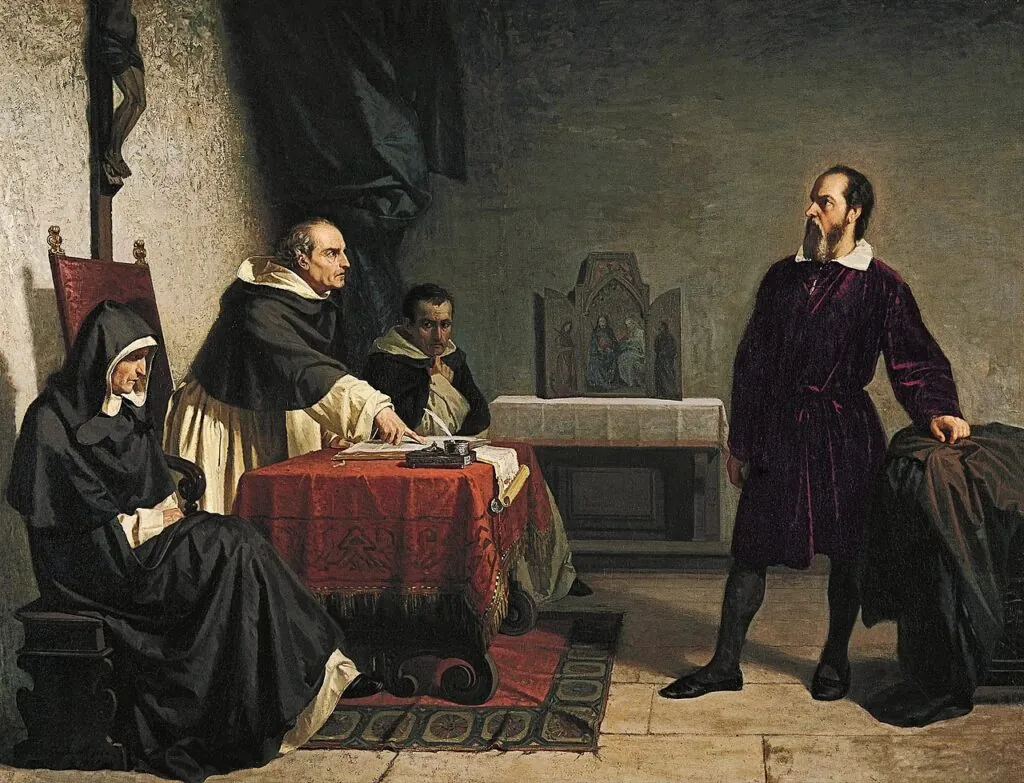
Cristiano Banti's painting from 1857, Galileo facing the Roman Inquisition
1. A historical overview: From the dance of the stars to the equations of strings
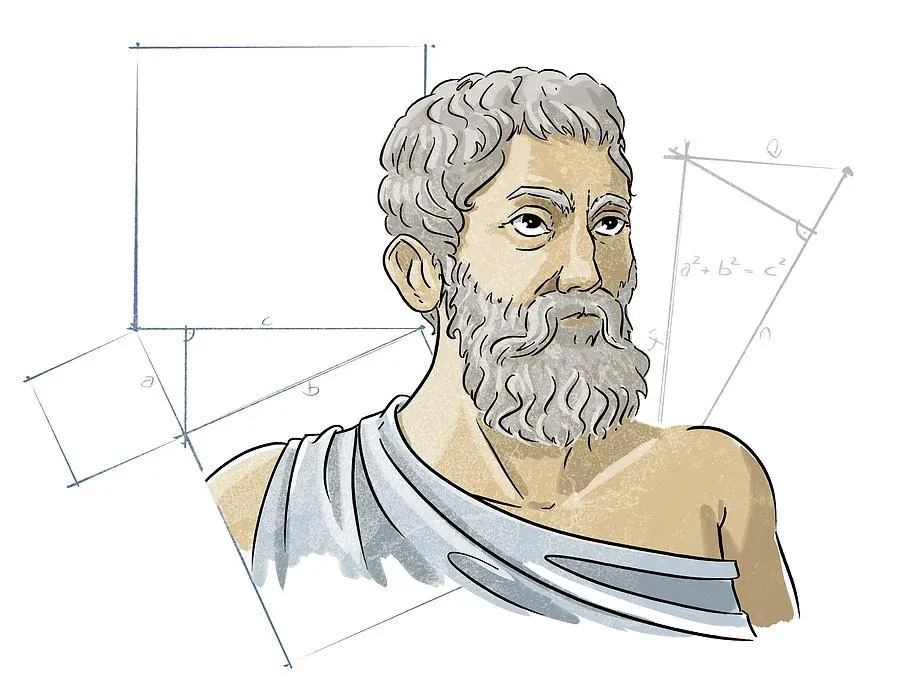
- Antiquity: Babylonian astronomers used geometry to predict eclipses, while Pythagoras saw in numbers “the essence of everything”.
- Newton's revolution: The laws of motion and gravity were born thanks to mathematical analysis. Here physics demanded new mathematics – the calculus developed by Newton and Leibniz.
- The 20th century: Einstein turned Riemann's non-Euclidean geometry into the foundation of general relativity (1915). Quantum mechanics transformed linear algebra into the language of probabilities.

2. Mathematics: Language or prophet?
Physics uses mathematical structures to encode reality, but sometimes mathematics predicts physical phenomena:
- Maxwell's equations (1860s) predicted the existence of radio waves.
- The Higgs theory (1964) described a boson that was only discovered experimentally in 2012.
- Antimatter was predicted mathematically by Dirac (1928) before it was discovered experimentally.
Here mathematics plays the role of a “prophet” whose abstract models reveal the secrets of the universe.
3. Physics: A laboratory for mathematical experiments
Conversely, physical problems stimulate new mathematical theories:
- Differential calculus was born from the need to describe acceleration.
- Chaos theory arose from attempts to model atmospheric conditions.
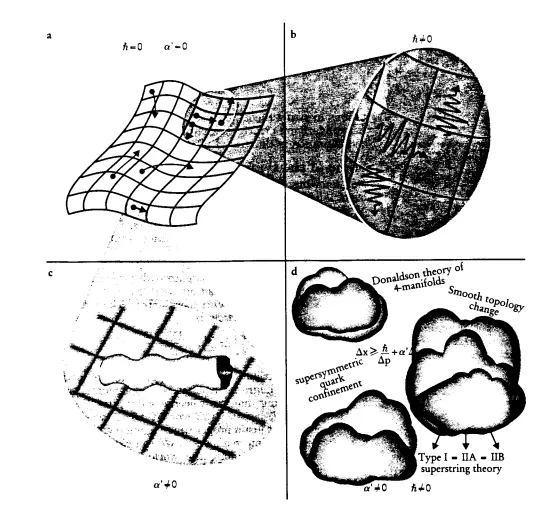
- String theory drives developments in topology and algebraic geometry.
As the mathematician Eugene Wigner put it: “The unreasonable effectiveness of mathematics in the natural sciences is a gift we don't understand.”
4. Can one exist without the other?
- Pure mathematics (e.g. number theory) exists as an abstraction, independent of applications.
- Physics, however, can't function without the mathematical apparatus. Even qualitative descriptions (e.g. “heat”) become quantitative laws through equations.
But this dualism is fruitful: mathematics offers the freedom of imagination, and physics ties it to reality.
5. The philosophical horizon: Is this dance a coincidence?
Modern debates raise questions:
- Why do mathematical models describe the Universe so precisely?
- Are physical laws “chosen” from infinite mathematical possibilities (according to Edward Witten)?
- Or is mathematics the essence of reality itself (Platonism)?
Conclusion: The dance that creates knowledge
Mathematics and physics aren't just tools for describing reality – they're the two poles of the human mind that reveal the very essence of being. Like the pair chronos and kairos in ancient Greek philosophy, mathematics shapes time as a quantitative grid, while physics turns it into a story of change. This symbiosis is older than Pythagoras' numbers and bolder than Heisenberg's uncertainty principle. It's a metaphysical bridge between the ideal and the material, between what can be imagined and what can be proved.
If we look through the lens of Platonic idealism, mathematics is the realm of eternal forms – the triangle exists before it's drawn, and the number π is a constant even in the emptiness of hypothetical universes. Physics, on the other hand, is the Aristotelian realization of these forms – it tells us where and how π hides in the curves of space-time or the spirals of galaxies. Together they turn chaos into a symphony: Laplace's deterministic equations collide with Lorenz's chaotic attractors, and the principle of least action leads to elegant solutions that Emmy Noether would call “the symmetries of nature”.
But what lies behind this harmony? Are mathematical structures the program code of the Universe, as Max Tegmark believes, or just convenient abstractions, as Richard Feynman insisted? The answers are hidden in the paradoxes:
- Gödel's theorem reminds us that every mathematical system contains undecidable questions – perhaps this is where physics steps in to “choose” which axioms are relevant to our reality.
- Quantum entanglement, for its part, calls into question the locality of space, forcing mathematics to invent new languages – from hypergraphs to multidimensional manifolds.
The theory of everything
In the future, when the “theory of everything” (if it exists) rises like a Monolith of knowledge, it will be neither pure mathematics nor pure physics. It will be their dance in its highest form – a synthesis in which the strings of M-theory vibrate in time with the Yang–Mills equations, and dark energy becomes new chapters in Galileo's book.
“When mathematics describes reality, it doesn't limit it – it gives it wings.” This winged reality is also a provocation: every time physicists discover a new particle model, mathematicians confront them with an infinity of possibilities. And conversely – every time mathematicians define a new abstraction, physicists ask: “What does this mean?” This is the dialogue that turns people from observers into co-creators of knowledge.
Ultimately, the dance between mathematics and physics is an ontological ritual. It not only explains the laws of nature but also reveals that only by intertwining them do we arrive at answers that give rise to more questions. And while the stars keep dancing their hyperbolic orbits and the quarks their quantum ballet, the human spirit will keep searching for a new step in the dance – a step that may lead to even deeper mysteries, or to a final harmony that unites all the notes of the cosmic symphony.
“When mathematics describes reality, it doesn't limit it – it gives it wings.”
On the Artec Robotics “News” page you will find a variety of articles and guides on robotics and automation. Here you'll find useful information about the latest technologies, software solutions and programs that will help you dive deeper into the world of industrial robots and automated systems.
Follow the news from Artec Robotics!
MAKE AN INQUIRY