The MQTT protocol: A complete guide for Industry 4.0 and IoT applications
With the arrival of Industry 4.0 and the Internet of Things (IoT), data exchange between devices, machines and cloud platforms is becoming critically important. One of the most efficient and lightweight protocols for this is MQTT (Message Queuing Telemetry Transport). Thanks to its reliability and minimal resource requirements, MQTT is becoming the communication standard in industrial environments, smart factories, sensor networks and intelligent control systems.
In this article we'll look at what MQTT is, how it works and why it suits Industry 4.0, as well as its advantages, architecture and practical applications.
What is MQTT and why is it ideal for IoT?
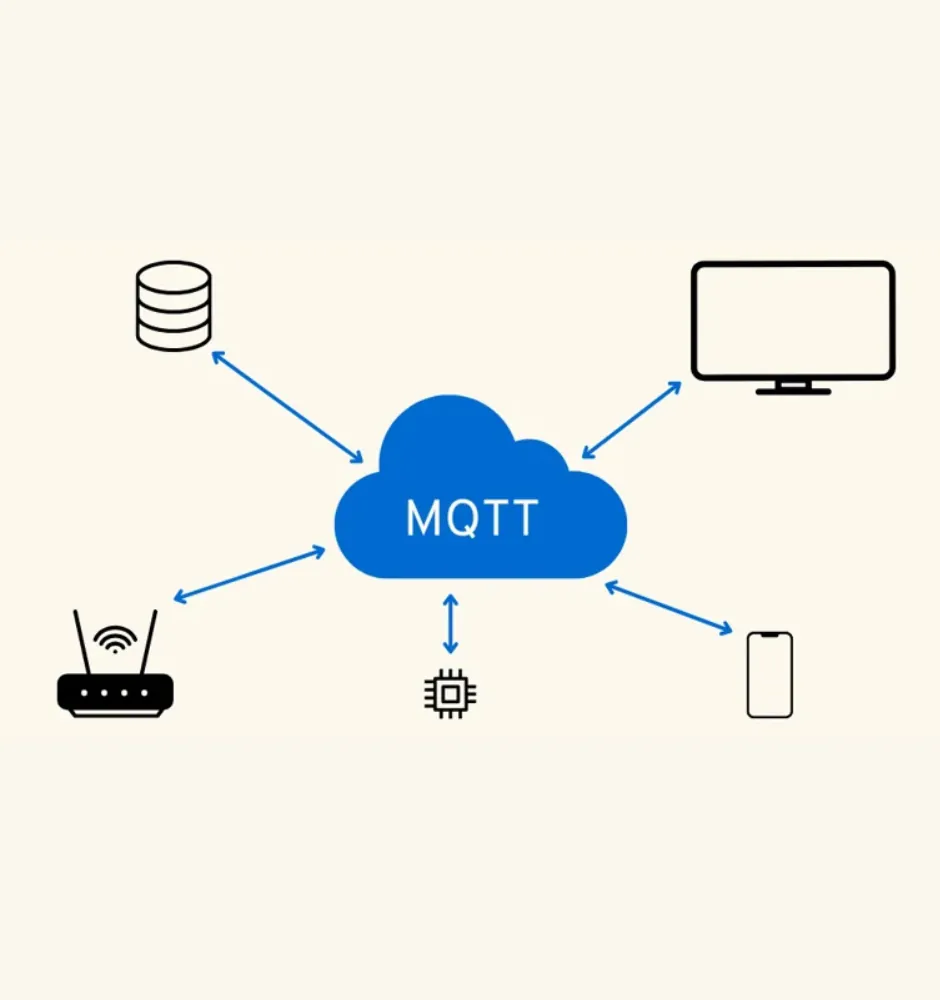
MQTT is a lightweight messaging protocol based on publish/subscribe. It was designed specifically for resource-constrained devices and for networks with low bandwidth or high latency. Unlike traditional client-server models, where the client has to actively request data from the server, MQTT takes a different approach.
In MQTT, communication runs through a broker. Clients that want to send data (for example, a temperature sensor) are called “publishers”. They publish messages on a particular topic to the broker. Clients that want to receive this data (for example, a monitoring system) are called “subscribers”. They subscribe to specific topics, and the broker automatically forwards them all new messages published on those topics.
This model offers several key advantages that make it extremely well suited to IoT and Industry 4.0:
- Lightweight and efficient: The MQTT message header is minimal (just 2 bytes), which reduces network load and energy consumption. This is ideal for battery-powered devices.
- Publish/subscribe: Separating the sender and the receiver of data allows great flexibility. Publishers and subscribers can work independently of each other, without needing to know who is at the other end. One publisher can send data to many subscribers and vice versa.
- Reliability: MQTT offers different levels of Quality of Service (QoS), which guarantees message delivery even on unstable networks.
- QoS 0 (At most once): The message is sent once, without acknowledgment. The fastest but least reliable level.
- QoS 1 (At least once): The message is guaranteed to be delivered at least once. Duplicates are possible.
- QoS 2 (Exactly once): The message will be delivered exactly once. The slowest but most secure level.
Applications of MQTT in Industry 4.0
MQTT is no ordinary protocol – it's a key component in building intelligent industrial ecosystems.
- Real-time monitoring: Sensors placed along production lines can publish data on vibration, temperature and pressure. Subscribing systems can use this data for predictive maintenance, anomaly detection or process optimization.
- Equipment control: Operators or automated systems can send commands to remote machines, such as switching a robotic arm on or off or changing process parameters.
- Logistics and supply chain: Goods-tracking devices can send location, temperature and humidity data in real time, providing transparency and control along the entire chain.
- Connected cars: In the automotive industry, MQTT is used to collect telemetry data from vehicles, for communication between cars and road infrastructure, and to send updates.
How to get started with MQTT: A quick guide
To build an MQTT-based system, you need a few basic components:
- MQTT broker: The server that manages communication between publishers and subscribers. Popular brokers are Mosquitto and HiveMQ. You can use a public broker for testing or set up your own for greater security.
- MQTT client libraries: To connect your devices and applications to the broker, you'll need client libraries. They're available for most programming languages – Python, C++, Java, JavaScript, etc.
- MQTT topics (Topics): The organized hierarchy under which messages are published and subscribed to. For example, factory/workshop1/sensor/temperature. Topics are key to filtering and routing messages efficiently.
Security and the future of MQTT
Security in IoT is essential. MQTT offers encryption via TLS/SSL, as well as user authentication with a username and password. To guarantee security, it's important to use these features, especially when transmitting sensitive data.
MQTT is more than a protocol – it's a core tool for the digital transformation of industry. Its lightweight architecture, flexibility and reliability make it the preferred solution for IoT applications, sensor networks and Industry 4.0.
If you're planning to deploy intelligent systems or integrate cloud services into your production, MQTT is the protocol that should be at the heart of your strategy.
On the Artec Robotics “News” page you will find a variety of articles and guides on robotics and automation. Here you'll find useful information about the latest technologies, software solutions and programs. They will help you dive deeper into the world of industrial robots and automated systems.
Follow the news from Artec Robotics!
MAKE AN INQUIRY