Quantum mechanics: How one theory changed everything (and why we still don't understand it all)
The world we can't see
Quantum mechanics is the science of the invisible – a theory that shatters our classical ideas of reality. It describes a world where particles are both waves and “solid objects”, and the future is a probability rather than a certainty. Without it we wouldn't have lasers, semiconductors or hope for quantum computers. But what makes it so revolutionary… and so confusing?
A short guide through history
- 1900–1913: The start of the quantum revolution
- Max Planck introduces the idea of “quantized energy” to explain why a hot body emits light.
- Einstein proves that light is a stream of particles (photons), explaining the photoelectric effect.
- Niels Bohr creates the model of the hydrogen atom with discrete electron orbits.
- 1920–1930: The birth of the theory
- Heisenberg develops matrix mechanics, and Schrödinger the wave equation.
- The Copenhagen interpretation (Bohr) becomes the “official” version: everything is a probability until it's measured.
Core principles: Why is the quantum world so strange?
- Wave-particle duality
An electron is a particle… until you don't observe it. Then it behaves like a wave. The double-slit experiment is the proof. - The uncertainty principle
It's impossible to measure a particle's position and velocity at the same time. Not because of bad instruments, but because that's how nature works. - Schrödinger's cat: Superposition
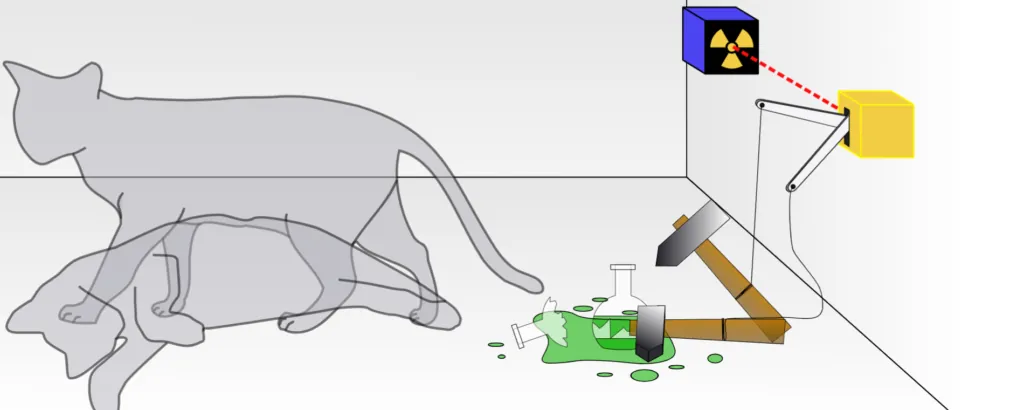
A particle is in all possible states at once… until you observe it. The famous thought experiment with the cat in a box illustrates the paradox. - Quantum entanglement: “Spooky action”
If two particles are entangled, a change in one instantly affects the other – even light years away. Einstein called this “spooky”, but experiments prove it's real.

Interpretations: How do we understand the impossible?
- Copenhagen: The wave function “collapses” on measurement. The observer is key.
- Many-worlds: Every measurement creates a new universe. If the cat is alive and dead, there are two realities.
- Pilot wave (Bohm): Particles have hidden trajectories, but this is rarely accepted.
Philosophical dilemmas: What is reality?
- Determinism vs. chaos: Classical physics believed everything was predictable. Quantum mechanics showed that probabilities rule.
- The role of the observer: Does measurement require human consciousness? Or is any interaction an “observer”?
- Nonlocality: Bell's theorem (1964) confirmed that quantum phenomena are nonlocal – but without breaking the speed of light.
A technological revolution: From theory to practice
- Quantum computers: Use superposition and entanglement to solve problems beyond classical computers.
- Quantum cryptography: Secure communication protected by the laws of physics.
- Lasers and transistors: Without quantum mechanics we wouldn't have modern electronics.
The future: Is there still more to discover?
- Quantum gravity: Attempts to unify it with general relativity (string theory, loop quantum gravity).
- Dark matter and energy: Will quantum physics explain them?
- Quantum artificial intelligence: Algorithms that solve problems in minutes instead of thousands of years.
The lesson of quantum mechanics
Quantum mechanics is a living theory. Its development continues with attempts to create a quantum internet, research into quantum phases of matter and the search for extraterrestrial life through quantum signals. Every new discovery has the potential to turn our world upside down – just as Planck and Einstein overturned the understanding of physics a century ago.
It teaches us two things: humility (nature can always surprise us) and courage (to look for answers outside our comfort zone). Despite a century of research, we still don't know whether the “cat” is alive, dead… or both. But that's exactly what makes it the most exciting science of our time.
On the Artec Robotics “News” page you will find a variety of articles and guides on robotics and automation. Here you'll find useful information about the latest technologies, software solutions and programs. They will help you dive deeper into the world of industrial robots and automated systems.
Follow the news from Artec Robotics!
MAKE AN INQUIRY