The road to automation runs through management
If you work in an industrial environment, you've probably already realized the potential of robotic automation – higher efficiency, lower production costs, better quality and competitiveness. But does management see the same thing?
Convincing the management team to invest in industrial robots and automation isn't just a matter of enthusiasm or technical facts – it takes a strategic presentation that addresses their priorities and concerns.
Why management may hesitate
As engineers and technical specialists, we often see automation as the logical next step. Management, however, has a different perspective. They have to think about profitability, process stability, risk management and the impact on staff. Here are some common concerns:
- “It's too expensive”
Automation can look like a serious upfront investment. If your proposal doesn't include concrete return on investment (ROI) calculations, management will probably say no. The price itself isn't the problem – the problem is the lack of arguments for why it's worth it.
- “The payback is too long or uncertain”
The bare price isn't as important as the payback period. You need to show clearly that the investment will pay for itself within an acceptable period – for example through lower labor costs, less scrap or shorter production cycles.
- “We don't have the resources to implement it right now”
Management may worry that the deployment will pull teams away from their core work. You need to show that the project can be managed in stages without disrupting current production schedules.
- “Employees will resist”
There may be concerns that automation will be seen as a threat to jobs. You need to emphasize that robots take on the repetitive, heavy or dangerous tasks – they don't replace operators, they support them.
- “Our processes are good enough right now”
If current production works, even with some shortcomings, management may not see a need for change. This is exactly where your job comes in – to show not just what can be improved, but what is lost if you don't act in time.
Six steps to building a convincing proposal
- Assess real feasibility
Not all processes are suitable for automation. Choose an area where the robot will have a clear effect – high repetition, routine operations, proven quality or safety problems.
- Prepare concrete data on the benefits
Don't talk in the abstract. Present hard numbers:
- By how much will production costs fall?
- By how much will capacity increase?
- By what percentage will cycle time or errors decrease?
- Understand the business priorities
Speak management's language. If their main focus is increasing productivity, show how automation speeds up production. If they're aiming for lower costs, demonstrate economies of scale.
- Translate technical benefits into strategic results
Don't say: “The robot has 6 axes of motion and accuracy of up to 0.05 mm”
Say: “This will let us take on high-precision orders that we currently outsource – and so keep more customers in-house.”
- Rehearse your presentation
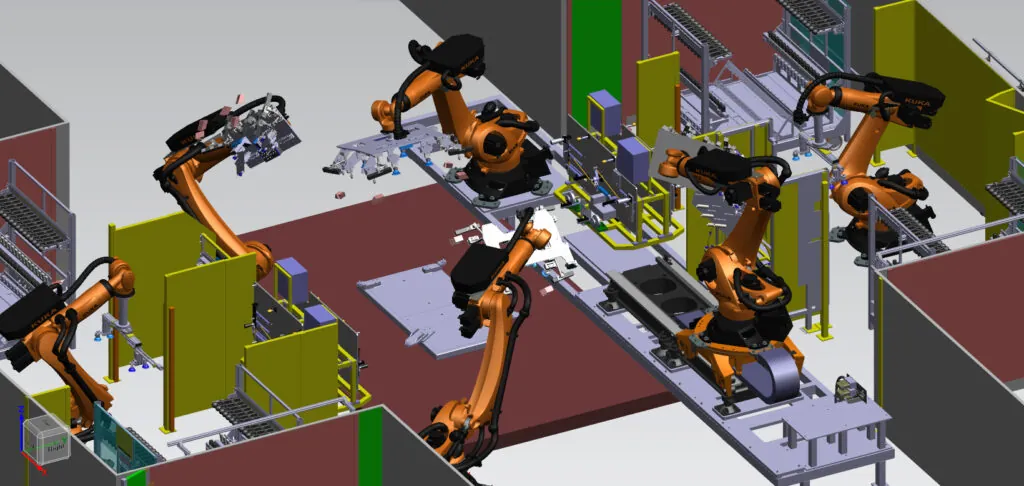
A confident, clearly structured presentation makes a huge difference. Prepare a short, concise summary with charts, ROI calculations and a concrete implementation plan. If possible, prepare a 3D simulation of the cell or process.
- Present your proposal formally
Schedule a meeting – don't do it in passing in the corridor. Present it as a business proposal with a clear goal, timeline and options for phased implementation. After the meeting, send a written summary and be available for further questions.
Added value: visualization and simulation
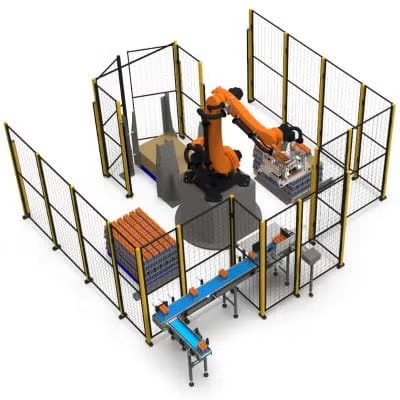
This isn't just a demonstration – it's proof of feasibility. Show them what the automated cell would look like, how much space it would take, how it would be controlled and how long one cycle takes.
We at Artec Robotics are here to help you in this process.
We offer full support in building an automation concept, including virtual demonstrations and simulations tailored to your specific production process.
We develop modular automated cells with industrial robots that can be deployed in any type of production – from single workstations to entire production lines. Our team will help you visualize the real benefit, the spatial layout and the efficiency of automation, even before the first robot is delivered.
With the right simulation and a professionally prepared proposal, your idea won't stay just a concept – it will become a real, measurable project with a high return.
Successfully presenting a robotic automation project requires not only technical expertise but also strategic thinking. To convince management, you need to speak their language – the language of returns, efficiency and long-term sustainability.
Back up your idea with concrete data, simulations and clearly justified benefits. Put yourself in management's shoes and show that automation isn't just a technological innovation but a logical business move.
You're not just proposing “a robot”.
You're proposing a solution that increases productivity, reduces costs, eliminates errors and builds a more competitive, flexible and sustainable company – ready for the challenges of the industry of the future.
On the Artec Robotics “News” page you will find a variety of articles and guides on robotics and automation. Here you'll find useful information about the latest technologies, software solutions and programs. They will help you dive deeper into the world of industrial robots and automated systems.
Follow the news from Artec Robotics!
MAKE AN INQUIRY