
Industry 4.0: Robots, Automation and Business Transformation
Home / Industry 4.0
A synthesis of strategic decisions, technology integration and Artec Robotics' role
Automation and the adoption of industrial robots are critical to the transition to Industry 4.0, where data, robotics and digital systems shape production and business models. This process isn't just a technology upgrade — it's a strategic restart for the organization. The question is when a company is ready for this transformation, and how companies like Artec Robotics can accelerate the transition with smart robotic solutions.
1 When is it time to automate with industrial robots?
Robotic automation makes sense when traditional methods limit growth and competitiveness. Key indicators:
1. Operational challenges
- High labor costs for repetitive tasks (e.g. manual welding, assembly).
- Frequent errors on production lines that lead to scrap and losses.
- Shortage of skilled staff for risky or precision operations (e.g. handling heavy loads).
2. Scalability and flexibility
- Inability to quickly reconfigure production when the product portfolio changes.
- The need for round-the-clock production (24/7) that human labor can't sustain.
3. Competitive advantages
- Competitors are already using cobots (collaborative robots) or automated warehouses.
- Customers demand customized products with short lead times.
4. Regulatory requirements
- Safety and quality standards (e.g. ISO 9001) that demand precision unattainable with manual labor.
2 Readiness for a restart with robotic solutions
A restart requires integrating robotics, IoT and data analysis. A company is ready when:
1. Infrastructure supports digital technologies
- Existing systems can be integrated with industrial robots (e.g. via APIs or cloud platforms).
- There's a way to collect and analyze production data in real time.
2. The organizational culture embraces change
- Management understands the value of robotic automation and invests in training.
- Employees are prepared to work alongside robots (e.g. programming, maintenance).
3. The financial plan is sustainable
- A budget is set aside for initial investment (robots, software, sensors) and long-term maintenance.
3 Artec Robotics' role in the transition to Industry 4.0
Artec Robotics offers full support to businesses at every stage:
1. Strategic analysis and design
- Process audit: Identifying critical points for automation (e.g. assembly, packaging, palletizing, welding, etc.).
- Proof of concept (PoC): Pilot projects with robots (e.g. SCARA for fast tasks, articulated robots for complex operations).
2. Technology integration
- Modular solutions like ART-CELL: Automated production cells that combine robots (KUKA, ABB, FANUC), IoT sensors and ERP systems.
- Intelligent systems:
- Robots with machine learning for predictive maintenance (e.g. predicting failures).
- Cobots that work alongside people (e.g. feeding components).
3. Training and adaptation
- Staff training:
- Robot programming with RobotStudio (ABB) or KUKA.Sim (KUKA).
- Managing data from IoT sensors.
- Technical support: Troubleshooting and performance optimization.
4. Sustainable solutions
- Energy efficiency: Low-power robots and waste recycling.
- Scalability: Adding new robots or modules without changing the entire system.
4 Implementation steps and challenges
Automation stages with Artec Robotics
- Audit and planning: Determining the ROI for each task.
- Technology selection:
- RPA + robotics: Automating administrative and production processes.
- AI-based robots: For adaptive tasks (e.g. sorting products with computer vision).
- Pilot deployment: Testing in a controlled environment.
- Scaling: Extending automation across the entire production cycle.
Challenges and solutions
- High upfront cost: Financing models with leasing or government subsidies.
- Resistance to change: Demonstrating robot effectiveness (e.g. a robot handling 200 products/hour vs. 50 manually).
- Complex integration: Using standards like OPC UA for communication between systems.
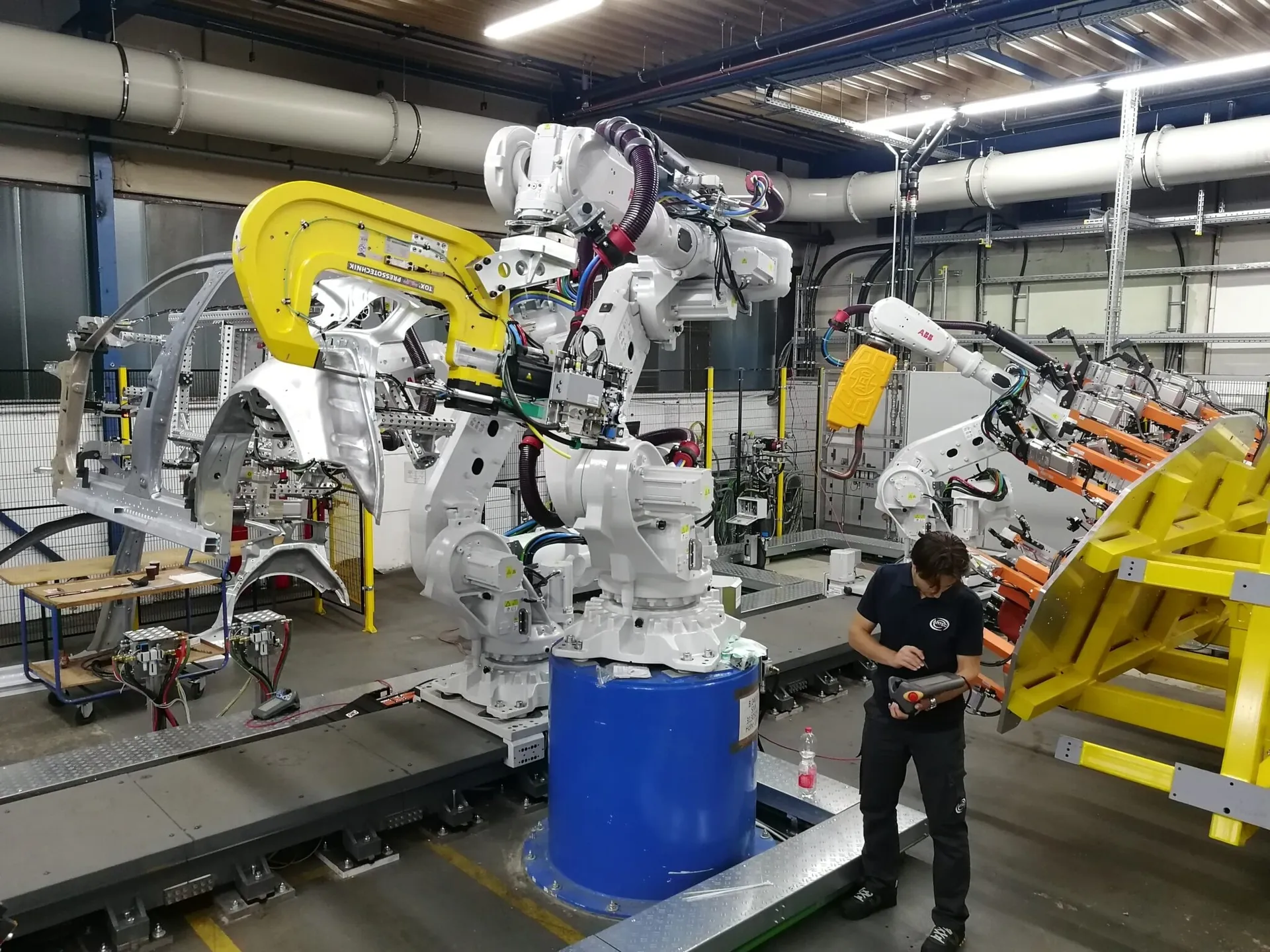
A strategic move, not an expense
Automation with industrial robots is an irreversible part of Industry 4.0, but success depends on strategic planning and partnerships with experts like Artec Robotics.
Readiness analysis
Identifying operational weak points.
Customized solutions
A combination of RPA, AI and IoT.
Gradual rollout
Piloting, training, scaling.
A real-world example
An electronics factory deployed Artec Robotics' ART-CELL modules, resulting in:
70%
reduction in production errors
60%
increase in capacity through continuous production
Sensor integration in quality control.
Investing in robotic automation isn't an expense — it's a strategic move for sustainable growth in the digital era.