IFR 2025: Industrial robots doubled in 10 years. See the latest data, robot density (China, Korea) and forecasts up to 2028
International Federation of Robotics (IFR)
This article presents the key findings of the IFR report for 2024 and 2025, analyzing regional differences, leading industries, the concept of robot density and the future trends that will shape the manufacturing landscape up to 2028.
The global scale: robotization doubles
In 2024, 542,000 new industrial robots were installed worldwide. This is the second-highest annual figure in history and more than double the installations of ten years ago.
As of 2024, the total operational stock of industrial robots in factories worldwide reached 4.664 million units – an increase of 9% on the previous year.
This expansion is a direct result of:
- The need to increase productivity and quality.
- Growing pressure to adapt to changing demand (more customization).
- Trends toward reshoring and nearshoring of production, which require automation to stay competitive.
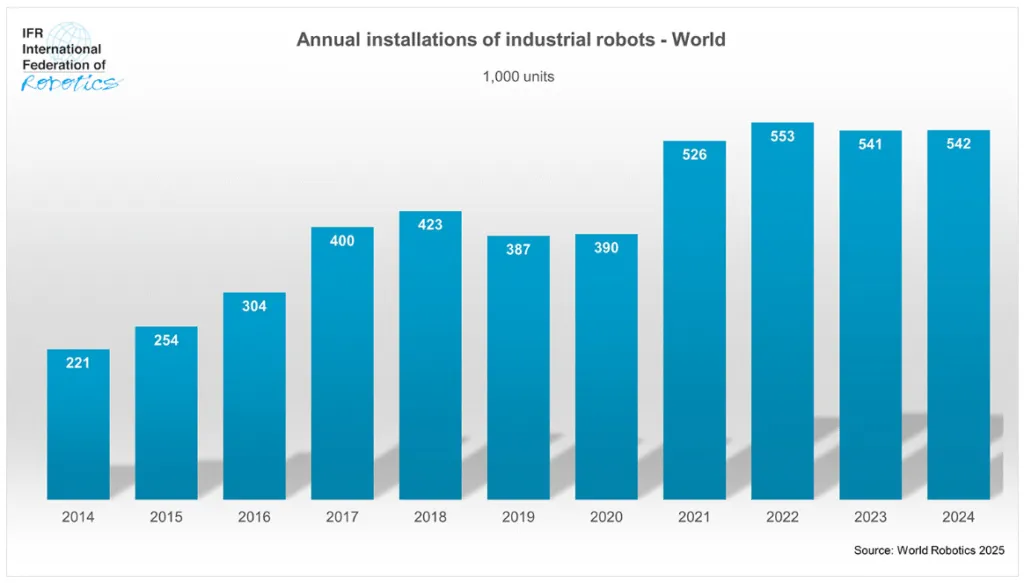
Annual installations of industrial robots worldwide. | Source: IFR
Regional markets: Asia dominates, Europe and the Americas adapt
The regional distribution of new installations in 2024 shows clear dominance:
- Asia: 74% of all new deployments.
- Europe: 16% of new deployments.
- The Americas: 9% of new deployments.
The Asian engine: China, Japan and Korea
China remains the largest market in the world with 295,000 units installed in 2024, representing 54% of the global market share. China's operational stock exceeded 2 million robots. Interestingly, for the first time, domestic Chinese manufacturers sold more robots on the home market than foreign suppliers.
Japan (44,500 installations) and the Republic of Korea (30,600 installations) remain among the largest markets, despite a slight decline in annual installations.
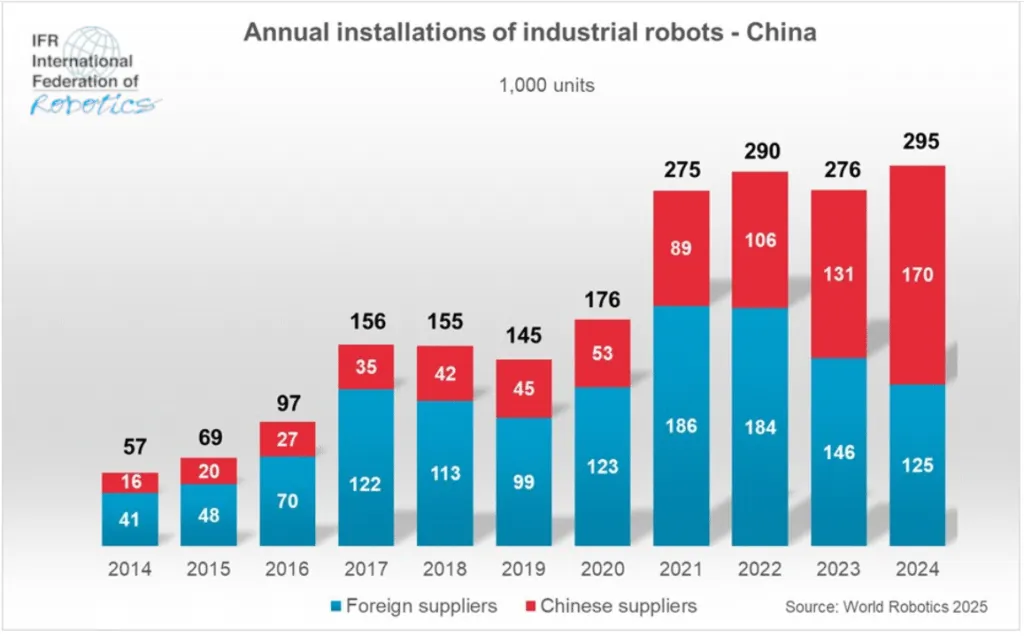
Annual installations of industrial robots in China, 2014 to 2024. | Source: IFR
Europe and the Americas: A focus on system integration
Although installations in Europe and the Americas dipped slightly in 2024 because of macroeconomic factors, the long-term trend remains strong.
- Germany remains the largest European market and the fifth largest in the world.
- The US is the largest market in the Americas, with the automotive industry still a key customer. In these regions, system integrators play a key role in deploying complex automated solutions.
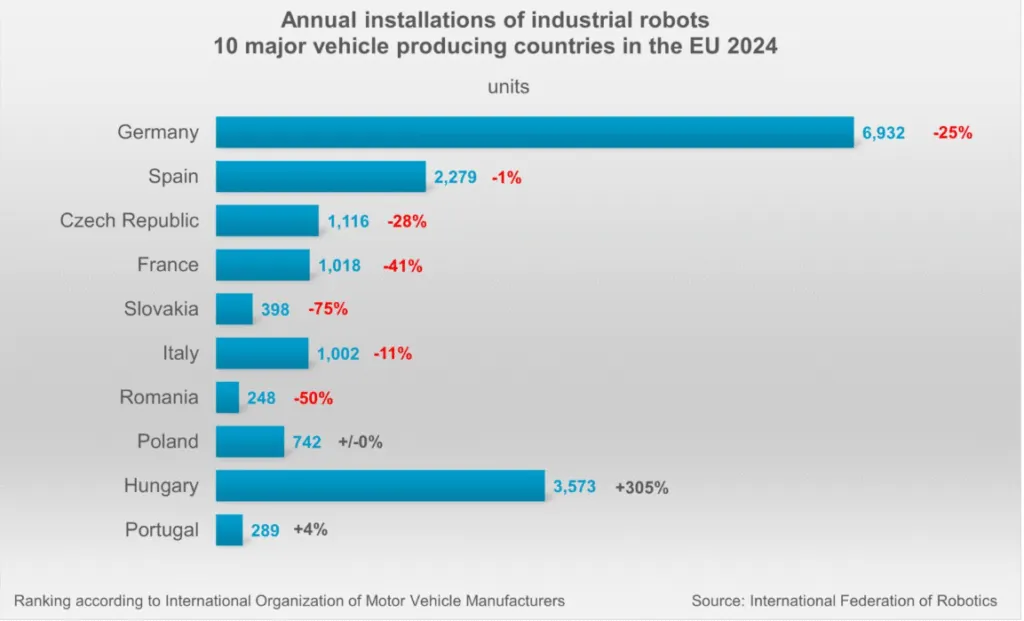
The IFR said it does not expect the EU automotive industry to drive robotics growth in 2025. | Source: IFR
Robot density: The barometer of automation
Robot density (the number of industrial robots per 10,000 employees in manufacturing) serves as a barometer of the degree of automation. The global average density has doubled over the past seven years, reaching 162 units per 10,000 employees in 2023.
Top 3 for robot density (as of 2023):
- Republic of Korea: Over 1,000 robots per 10,000 employees.
- Singapore: 770 robots.
- China: 470 robots (a dramatic jump, overtaking Germany and Japan by doubling its density in just four years).
High robot density is directly linked to the increased competitiveness and productivity of the national economy.
Leading applications and industrial sectors
Although the automotive industry has traditionally been the main customer for industrial robots, new data shows strong growth in general industry.
- Electrical/electronics industry
In recent years this sector has been a key driver, especially in Asia. Robots are used for precision operations such as assembling micro-components, testing and visual inspection with the help of computer vision.
- Automotive industry
The sector continues to invest heavily, especially in the transition to electric vehicles (EVs). Robotization is essential for building flexible battery and chassis production lines.
- Metal and machinery industry
This sector relies heavily on automation for welding, palletizing and material handling, with steady growth in installations.
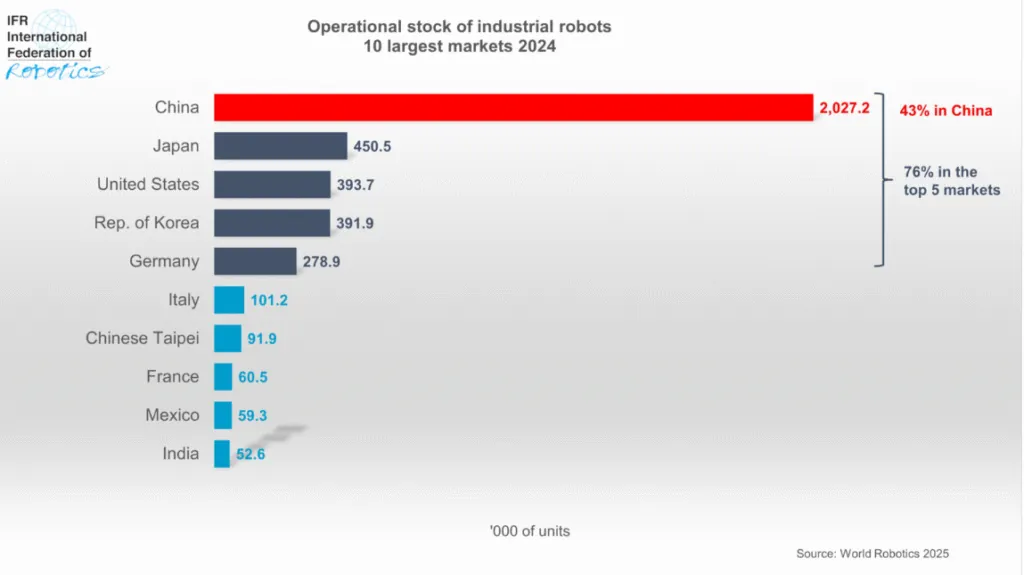
China has five times the operational stock of industrial robots of the US | Source: IFR
Future trends: Cobots and forecast growth
The IFR forecast for the future is clear: the long-term growth trend in robotization will continue.
- Short-term forecast: Global installations are expected to grow by 6% in 2025, reaching 575,000 units.
- Long-term forecast: By 2028, annual installations are forecast to exceed 700,000 units.
The role of cobots
Collaborative robots (cobots) are becoming more affordable and easier to deploy, especially for small and medium-sized enterprises (SMEs). They work in close proximity to people, increasing the flexibility and safety of the working environment. Cobots are key to overcoming labor shortages and automating less standard processes.
Industrial robotization is no longer a luxury for large corporations but a necessity for keeping production competitive and flexible. Manufacturers who invest in automation and system integration will be the leaders of the economy of the future.
On the Artec Robotics “News” page you will find a variety of articles and guides on robotics and automation. Here you'll find useful information about the latest technologies, software solutions and programs. They will help you dive deeper into the world of industrial robots and automated systems.
Follow the news from Artec Robotics!
MAKE AN INQUIRY