Gennaris Bionic Vision System: A revolutionary leap in restoring sight to the blind
In a world where over 36 million people live with blindness, the Gennaris Bionic Vision System is emerging as a ray of hope. Developed by researchers at Australia's Monash University, this innovative technology promises to restore functional vision to millions, overcoming the limitations of traditional eye implants. By communicating directly with the brain's visual cortex, Gennaris bypasses damaged eyes and optic nerves, offering a solution for people previously considered irreversibly blind.
How does Gennaris work? A symphony of technologies
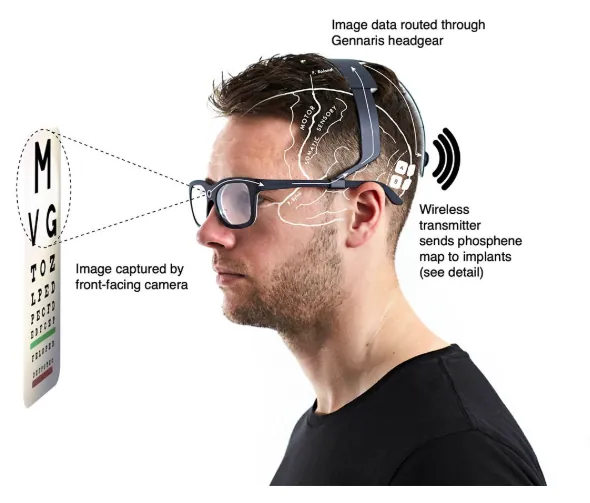
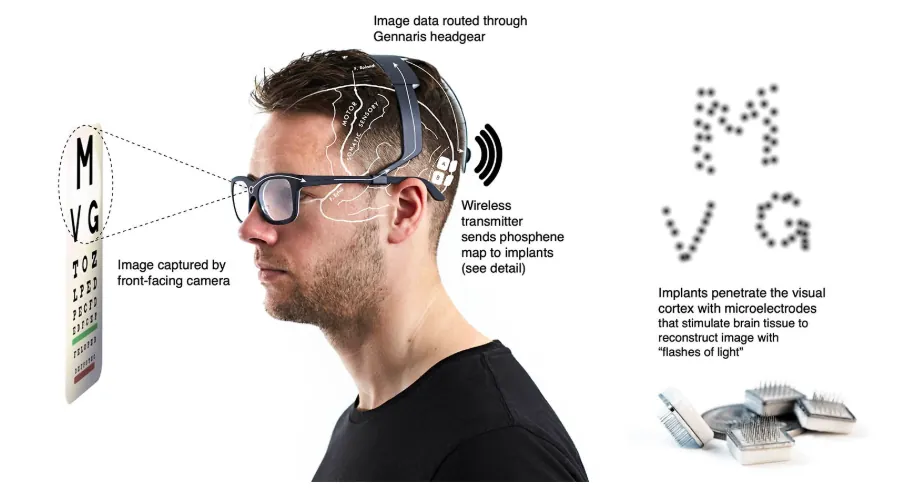
- Image capture: The system starts with a lightweight camera mounted on glasses that captures visual data in real time.
- Processing: A portable device (similar to a smartphone) uses artificial intelligence algorithms to convert the images into electrical signals. Unlike retinal implants, Gennaris optimizes the data so the brain can understand it more easily.
- Transmission: The signals are sent wirelessly to a 9×9 mm implant embedded in the visual cortex. This eliminates the need for invasive cables.
- Stimulation: The implant, fitted with 473 microelectrodes, creates phosphenes (points of perceived light) that form a two-dimensional visual field. Users learn to interpret these patterns as shapes, movement or text.
Development and innovation
Led by Professor Arthur Lowery and the Monash Vision Group team, Gennaris is the result of over 10 years of research. Funded by Australia's National Health and Medical Research Council, the project brings together neuroscience, engineering and artificial intelligence. Key innovations include:
- High-density electrodes: Provide higher resolution than predecessors such as the Argus II.
- Wireless design: Reduces the risk of infection and improves mobility.
- Focus on the cortex: Suitable for patients with glaucoma, damaged optic nerves or retinal degeneration.
Clinical research
Early tests on sheep proved the implant's safety and effectiveness. In 2021 the first human experiments began – participants reported perceiving phosphenes and simple shapes. Challenges such as minimizing scarring in brain tissue and improving resolution remain, but the team is actively working on them.

Comparison with other technologies
Unlike retinal implants (e.g. Argus II), which require functioning optic nerves, Gennaris stimulates the brain directly. Compared with brain implants such as the Utah Array, the system offers a wireless connection and a higher electrode density, although its resolution is lower than natural vision (~equivalent to 20/1200).
Ethical and practical questions
- Accessibility: The price of ~US$250,000 puts the technology out of reach for many. Researchers are pushing for coverage by insurance and government subsidies.
- Risks: Implantation requires brain surgery, which carries a risk of infection or epileptic seizures.
- Ethics: There are discussions around patients' informed consent and prioritizing conditions that can be treated with neuroprosthetics.
The future of the technology
The Monash University team aims to commercialize Gennaris within the next 5 years. Future versions may include:
- AI integration for automatic recognition of objects or faces.
- Improved resolution through miniaturization and more electrodes.
- Combination with audio cues to enrich perception.
Impact on society
Gennaris could transform the lives of blind people, enabling them to get around independently, read or recognize loved ones. This would reduce the economic burden of care and improve quality of life. The system's success could inspire breakthroughs in treating paralysis or deafness through similar neurotechnologies.
Conclusion
The Gennaris Bionic Vision System isn't just a medical device – it's a bridge between science and human dreams. Although it doesn't replace perfect vision, it brings hope to millions, turning science fiction into reality. With every successful operation and improvement, the technology reinforces the idea that blindness isn't an end but a challenge that human ingenuity can overcome.
To follow the latest developments of the Gennaris Bionic Vision System at Monash University, visit: https://www.monash.edu/bioniceye/technology
On the Artec Robotics “News” page you will find a variety of articles and guides on robotics and automation. Here you'll find useful information about the latest technologies, software solutions and programs that will help you dive deeper into the world of industrial robots and automated systems.
Follow the news from Artec Robotics!
MAKE AN INQUIRY