From the Ishango bone to quantum computers, numbers are humanity's first language and the secret code of the Universe. A journey through the history, physics, technology, art and philosophy of mathematics, with a look at its unsolved mysteries and the number π.
I. Numbers – Humanity's first language
1.1. Prehistoric foundations
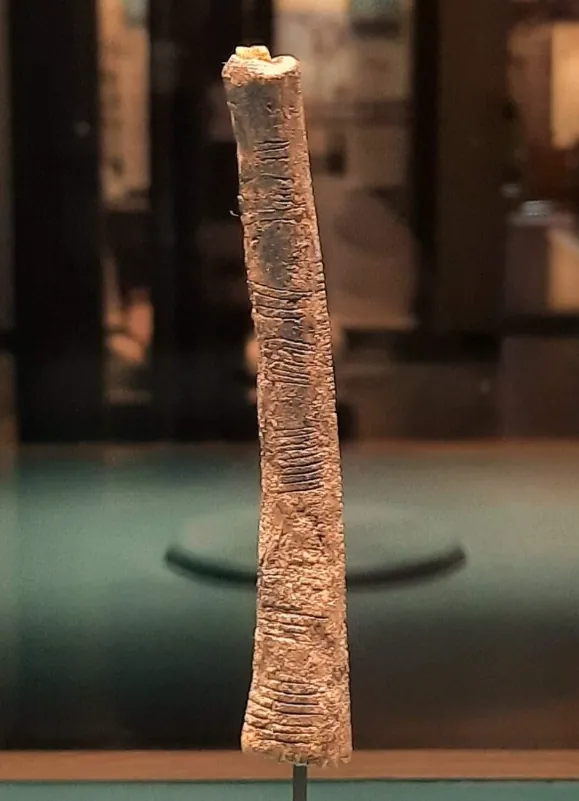
- 30,000 BC: The Ishango bone (Congo) – the oldest known “calculating device”, with markings for lunar cycles.
- Ancient Egypt: A papyrus scroll with an equation for the volume of a pyramid:

- where a and b are the bases and h is the height.
1.2. Numbers in culture
- Babylon: The sexagesimal number system, which survives in how we measure time (60 minutes, 360° in a circle).
- The Maya: Zero as a concept – 1,000 years before Europe.
II. The Universe as a mathematical novel
2.1. The cosmic symphony
- The golden ratio (φ):
- The spiral of the Milky Way galaxy follows φ.
- Ocean waves break in a ratio of 1:1.618.
- The Drake equation: An estimate of the number of extraterrestrial civilizations:

2.2. The quantum world – where numbers are “illogical”
- Heisenberg's uncertainty principle:

- It's impossible to measure position and momentum precisely at the same time.
- Quantum bits (qubits): Their state is described with complex numbers:

III. The technological revolution: When abstractions become reality
3.1. Algorithms that run the world
- Google PageRank: Ranking web pages using matrices and eigenvectors:

- Blockchain: Elliptic curve cryptography – the equation:

3.2. Artificial intelligence – mathematics in human form
- Convolutional neural networks (CNNs): Image recognition filters based on matrix operations.
- Gradient descent: Minimizing error using derivatives:

IV. Mathematics as a survival tool
4.1. Medicine: The equations that heal
- The SIR model for epidemics:

- Used to forecast COVID-19 waves.
- MRI: The Fourier transform for reconstructing 3D images.
4.2. Economics: The numbers game
- Game theory: Nash equilibrium in trade agreements:
- Each player maximizes their payoff given the strategies of the others.
- The Black-Scholes model: Pricing financial derivatives:

V. Philosophy: Numbers as a metaphysical riddle
5.1. Platonism vs. Nominalism
- Plato: Numbers are eternal ideas in the “world of forms”.
- Hobbes: “Mathematics is just a language invented by people.”
5.2. Gödel's theorem: The limits of mathematics
- First theorem: “Any sufficiently complex system is either incomplete or inconsistent.”
- Consequence: There are truths that can't be proved (e.g. the continuum hypothesis).
VI. Unsolved mysteries: Where is the limit?
6.1. The Riemann hypothesis
- “The zeros of the zeta function have real part 1/2.”
- Impact: If it's true, we'll understand the distribution of prime numbers.
6.2. P vs NP
- The question: Can every problem that can be checked quickly also be solved quickly?
- Example: Satellite navigation uses NP problems – if P=NP, cryptography would collapse.
6.3. The Navier-Stokes equations
- They describe the motion of fluids.
- The problem: We don't know whether a smooth solution always exists – one of the 7 Millennium Prize Problems.
VII. Mathematics as art
7.1. The Renaissance: Perspective as an equation.
- Albrecht Dürer: “Four Books on Measurement” – geometry in art.
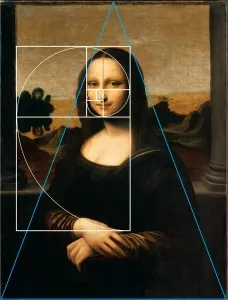
- The golden rectangle: Used by Leonardo da Vinci in the “Mona Lisa”.
7.2. The music of the spheres
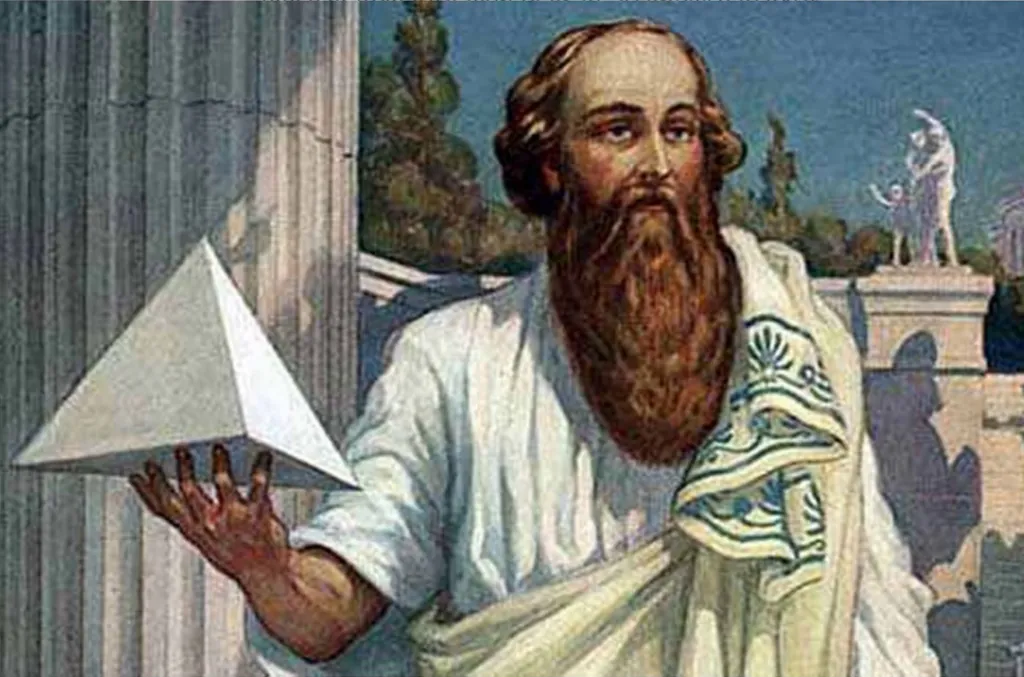
- Pythagoras: Discovered that intervals (octave, fifth) are related to simple fractions (2:1, 3:2).
- Fourier: Every musical note can be broken down into sine waves.
The number π: The mathematical constant that captivates the world
- The basics: What is π?
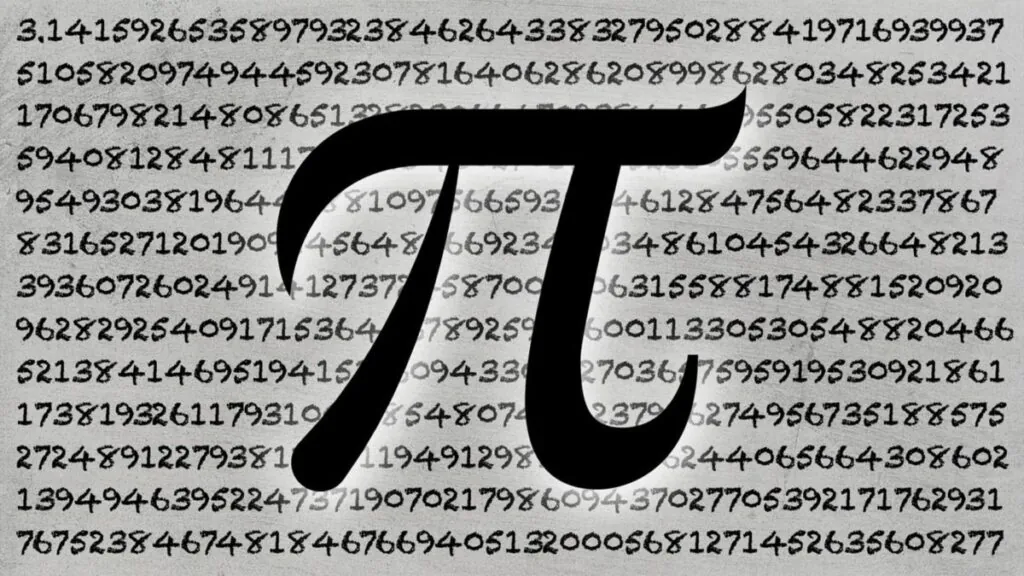
π (pi) is the ratio of a circle's circumference to its diameter. Its value is approximately 3.1415926535…, but it never ends and has no repeating pattern. This makes it an irrational and transcendental number.
- Historical races for accuracy
- Babylon (2000 BC): An approximation of 3.125.
- Egypt (the Rhind Papyrus, 1650 BC): π≈25681≈3.1605π≈81256≈3.1605.
- Archimedes (3rd century BC): Used polygons to prove that 3.1408<π<3.14293.1408<π<3.1429.
- Modern calculations: Supercomputers have calculated over 62 trillion decimal places (2021).
- π everywhere – even beyond geometry
- Physics: Equations of pendulum motion, wave functions in quantum mechanics.
- Probability theory: The formula for the normal distribution:
f(x)=1σ2πe−(x−μ)22σ2f(x)=σ2π1e−2σ2(x−μ)2
- Cosmology: π is hidden in calculating the volume of the Universe.
- Cultural significance
- Pi Day: Celebrated on March 14 (3/14 in the American format).
- Books and films: The novel “Life of Pi” and Darren Aronofsky's film “Pi” explore the mystical aspects of the number.
- Records: Japan's Akira Haraguchi has memorized over 100,000 digits of π.
- Riddles mathematicians have yet to solve
- Is π normal? It's believed that every digit (0-9) occurs with equal frequency in its infinite digits, but this hasn't been proved.
- Is it connected to other constants? Euler's formula eiπ+1=0eiπ+1=0 links π with ee and ii, but are there more connections?
- π in art
- Music: Composers turn the digits of π into notes (e.g. “Song from π” by David Macdonald).
- Architecture: The Tower of the Winds in Athens uses proportions based on π.
- Visual installations: Artists paint fractals using π to generate noise.
- Why is π so charming?
π is a symbol of the mystery of infinity and the universality of mathematics. Even if you don't do geometry, π reminds you that the Universe is encoded in numbers – and we're still reading only the first pages of this book.
VIII. Why does mathematics matter?
8.1. Mathematics as a bridge between disciplines
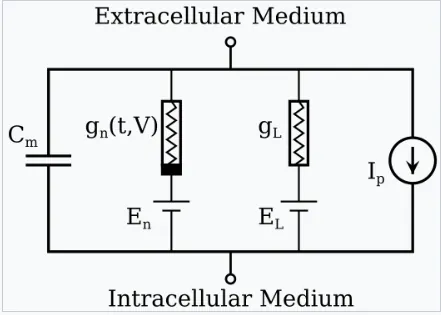
- Neuroscience: The Hodgkin-Huxley equations for nerve impulses.
- Climatology: Partial differential equations for forecasting warming.
8.2. Ethics and social responsibility
- Algorithmic bias: Linear regression can reproduce discrimination.
- Cryptography and freedom: RSA protects people's rights in the digital world.
The Hodgkin-Huxley model, or conductance-based model, is a mathematical model that describes how action potentials in neurons are initiated and propagated. It's a set of nonlinear differential equations that approximate the electrical characteristics of excitable cells such as neurons and muscle cells. It's a continuous-time dynamical system
Conclusion: Numbers as Prometheus' eternal fire
Mathematics isn't just a collection of formulas – it's curiosity, creativity and courage. From the ancient astronomers who risked their lives to prove the Earth is round, to modern cryptographers who protect democracy, mathematicians have been rebels with pencil and paper.
To our teachers:
Mathematics is the only discipline in which proof is an art – not just a chain of logical steps but a creative search for elegance, where every lemma or theorem is a brushstroke in a picture that reveals the hidden symmetry of chaos. It's also the only science in which uncertainty is a law – from Zeno's ancient paradoxes to Gödel's theorems, which teach us that even perfect systems have doorways to the infinite unknown. And most importantly: mathematics is the place where beauty is a criterion of truth – where Euler's equation (eiπ + 1 = 0) is poetry, and the Poincaré conjecture is a fairy tale waiting for its storyteller.
You, teachers, are the translators of this language between the stars and your students. You don't just teach formulas – you kindle the spark of “if”, “why” and “what if…”. Thanks to you, students see not just problems but doors to parallel worlds – where an integral is a bridge between motion and loss, and a matrix is a key to decoding reality.
Thank you for teaching us to read between the lines of the universe – not only with pencil and paper but with imagination and courage. Because mathematics isn't only about solving problems… it's about learning to ask questions the world can't yet answer.
— Your students, who now know that 1+1 isn't always 2… but sometimes is a whole new universe.
Numbers can make us smile – 9/17/9/14/1
On the Artec Robotics “News” page you will find a variety of articles and guides on robotics and automation. Here you'll find useful information about the latest technologies, software solutions and programs that will help you dive deeper into the world of industrial robots and automated systems.
Follow the news from Artec Robotics!
MAKE AN INQUIRY