5 signs it's time to automate your production
Every manufacturing business owner sooner or later asks the same question: “Are we ready for automation, or can we still wait?”. The answer rarely comes from a gut feeling — it comes from concrete, measurable signals that the production line sends every day.
The industrial robotics market has been growing at double-digit rates in recent years, and the reason isn't a passing trend but economic logic: manual labor is getting more expensive, skilled workers are becoming scarcer, and the competition is already running automated lines. Companies that recognize the signs of needing automation in time gain a decisive advantage over those waiting for “the perfect moment”.
In this article we look at the five clearest signals that your production is ready for robotization — and what each of them really means for your business.
1. You can't find enough skilled workers
Labor shortages are perhaps the most common reason manufacturers in Bulgaria turn to automation. Welding, machine tending and monotonous loading and packing operations are getting ever harder to staff — especially with workers willing to stay long-term.
If you regularly advertise vacancies for months on end, if you train a new employee only to lose them a few weeks later, or if your production stops because a key operator is absent — that's a clear signal. An industrial robot doesn't get tired, doesn't get sick, doesn't change employers, and works with the same quality at 3:00 at night as at 9:00 in the morning.
Robotic cells for welding or machine tending (machine tending) are an effective solution precisely for operations where skilled people are hard to find and keep.
2. Quality varies depending on who runs the line
When the same operation gives different results depending on the shift, the experience of the particular employee or even their mood on a given day — that's a costly problem. Variations in quality lead to scrap, complaints and lost customer trust.
Robots perform the same operation with identical precision thousands of times in a row. In welding, that means the same seam, the same penetration depth and the same joint strength — regardless of the hour, the day or the team's workload. With machine vision integrated for inspection, robotic systems can detect defects that easily escape the human eye during routine, repetitive work.
If the scrap rate is a main topic at every management meeting, the problem probably isn't your people but the process itself.
3. Labor costs are rising faster than revenue
Automation is often seen as a large capital investment — and that's true. But the real question isn't “how much does the robot cost”, but “how much does it cost NOT to automate”. The return on investment (ROI) for industrial robotization is usually calculated at 12 to 24 months, depending on how busy the line is and the number of shifts.
Work out the real cost of a single manual operation: salary, social security, training, staff turnover, overtime, errors and downtime. Compared with a one-off investment in a robot that works 24/7 without interruption, the math often quickly tips in favor of automation — especially in production running more than one shift.
If labor costs rise every year while your margins shrink, that's a financial signal that's hard to ignore.
4. Orders are growing, but production capacity can't keep up
Growing demand is good news — until you become the bottleneck in your own business. If you regularly turn down orders, extend delivery times or hire temporary staff just to cover the peaks, it means your production capacity no longer matches real market demand.
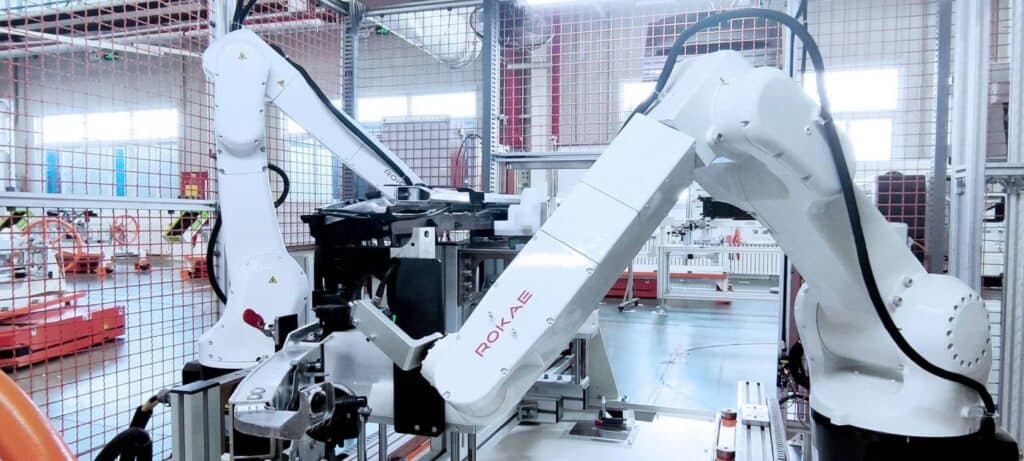
Modular robotic cells and cobots (collaborative robots) are well suited to exactly this scenario — they can be deployed relatively quickly, work alongside existing staff and increase output without the need to expand floor space or hire a new team. Unlike traditional rigid automated lines, modern robotic solutions are modular and scalable — they can grow together with the business.
5. Your competitors are already automating
Industrial robotization is no longer an advantage reserved for large factories. The robotics market is growing steadily precisely because small and medium-sized manufacturers are investing in cobot systems on a large scale, thanks to the lower capital risk and faster deployment compared with traditional heavy automation.
If a competitor in your industry has cut prices, shortened lead times or increased capacity without visibly adding staff — they are probably already running a robotic line. In this case, waiting isn't caution; it's a real risk of losing market share.
What to do if you recognize these signs
Recognizing one or more of these signals doesn't mean you have to automate your entire production at once. Successful robotization usually starts with one pilot operation — most often welding, machine loading/unloading or palletizing — and then expands step by step based on real results.
As the official distributor and integrator of ROKAE, Borunte and Aotai Electric and BINGO Welding welding equipment for Bulgaria, Artec Robotics approaches every project with a concrete analysis of the production process before proposing a solution — whether it's an industrial robot, a collaborative cobot or a mobile manipulator system.
Contact us for a free consultation and an assessment of the automation potential of your production.
On the Artec Robotics “News” page you will find a variety of articles and guides on robotics and automation. Here you'll find useful information about the latest technologies, software solutions and programs. They will help you dive deeper into the world of industrial robots and automated systems.
Follow the news from Artec Robotics!
MAKE AN INQUIRY