

More than 5 million industrial robots are now at work worldwide, and 2025 installations topped 600,000. Key data from World Robotics 2026 and what it means for manufacturers in Bulgaria.
Industrial automation has entered a new phase. According to the annual World Robotics 2026 report by the International Federation of Robotics (IFR), more than 5 million industrial robots are now operating in factories worldwide – a record more than double the level of seven years ago. For manufacturers in Bulgaria, Greece and Romania, the message is clear: robotisation is no longer a privilege of large car plants, it is a matter of competitiveness.
Key figures from the report
- 5 million industrial robots in operation at the end of 2025 (+9% year on year).
- Over 600,000 new installations in 2025 (+11%).
- 655,000 installations forecast by the IFR for 2026 (+9%).
- 806,000 new robots per year expected by 2029.
IFR President Jane Heffner summed up the trend by saying that industrial automation is progressing at high speed – strongest in Asia, followed by the Americas, while Europe is moving more slowly.
Which countries are automating fastest
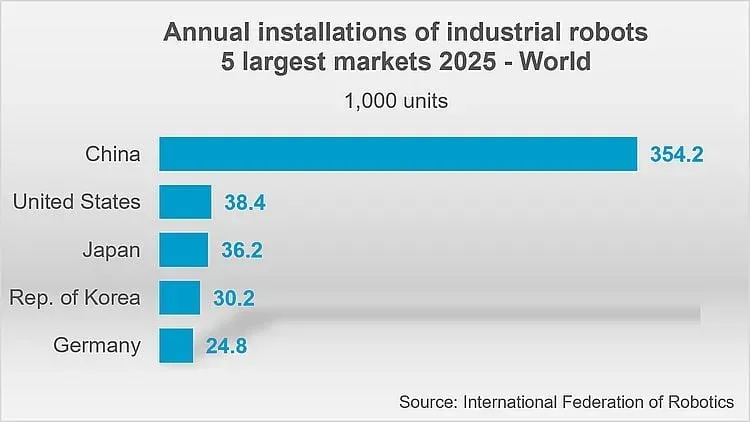
| Country | Installations in 2025 | Change |
|---|---|---|
| China | 354,000 | +20% |
| USA | ≈ 38,500 | +12% |
| Japan | 36,219 | −19% |
| South Korea | 30,000 | −1% |
| Germany | < 25,000 | −8% |
| India | ≈ 10,500 | +15% |
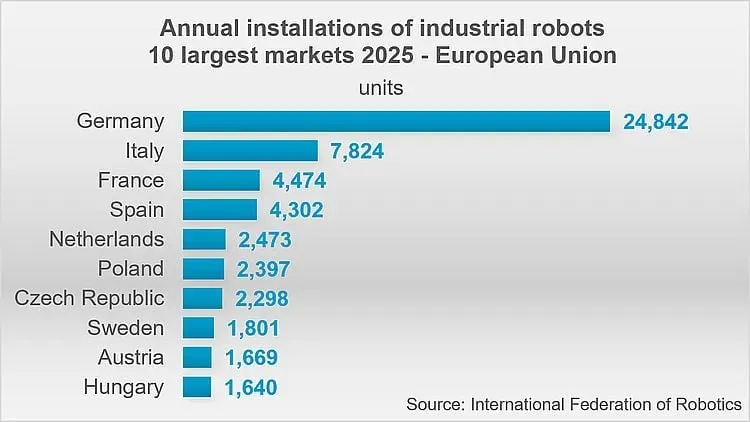
China accounts for 59% of global installations, and Chinese robot makers now hold 55% of their home market. The USA overtook Japan to become the second-largest market. Germany remains Europe's leader with 41% of EU installations, followed by Italy (about 7,800), France (about 4,500) and Spain (about 4,300).
Why Europe is lagging – and where the opportunity lies for South-East Europe
The decline in Germany, Italy and Spain is mainly due to weaker investment in the automotive industry. That does not mean European industry is losing interest in automation. On the contrary – demand is shifting towards smaller, flexible robotic cells for metalworking, welding, plastics, food processing and logistics.
This is exactly where the Balkans have an opening. Nearshoring production closer to Europe, rising labour costs and an increasingly severe shortage of skilled workers make robotisation a logical step for Bulgarian, Greek and Romanian companies that want to stay in the supply chains of major European manufacturers.
The three forces driving growth
1. Supply chain resilience
Trade and industrial policy are pushing companies to bring production closer to end markets. New plants mean new production lines – and new lines are increasingly designed with robots from the start.
2. Demographics and labour shortages
An ageing population and the difficulty of finding welders, operators and technicians are among the most common reasons our customers start talking about automation. The robot takes over repetitive, heavy and dangerous work, while people move to supervision, setup and quality control.
3. Artificial intelligence, machine vision and easy programming
The IFR explicitly points to advances in artificial intelligence, machine vision and sensors, as well as simpler programming, as factors that lower the cost of deployment. Today a collaborative robot can be "taught" a new task by hand-guiding or through a graphical interface, without months of programming.
What this means for your production
If you are an owner or production manager, here are a few questions worth asking yourself:
- Which operations are repeated thousands of times per shift? Welding, palletising, CNC machine tending and press tending are the classic candidates.
- Where do you lose the most time or quality? A robot delivers the same weld, the same cycle time and traceability for every part.
- How hard is it to find people for these positions? If you have been looking for a welder for months, a robotic cell may be the faster solution.
- What is the real return on investment? In two-shift operation, many robotic cells pay for themselves in 2–3 years.
How Artec Robotics helps companies take the first step
As the official ROKAE distributor and integrator for Bulgaria, Greece and Romania, and a partner of Aotai Electric, BINGO Welding, Borunte and ABB, Artec Robotics offers a complete path to automation:
- production analysis and ROI assessment;
- design and construction of robotic cells – for welding, palletising, machine tending and more;
- integration with machine vision and peripheral equipment;
- staff training at our training centre and service support.
Global data shows that robotisation is accelerating. The question is no longer whether, but when and where to start.
Want to find out which processes in your production can be automated? Contact the Artec Robotics team for a free consultation.
Frequently asked questions
How many industrial robots are operating worldwide in 2026?
According to the IFR's World Robotics 2026, the operational stock reached a record 5 million units at the end of 2025, up 9% on the previous year.
What are the largest markets for industrial robots?
China, the USA, Japan, South Korea and Germany, which is the largest market in Europe.
Is robotisation worthwhile for a small or medium-sized business?
Yes, especially for repetitive operations. Collaborative robots and easier programming have significantly lowered the barrier to entry into automation.